Showing posts with label comedy. Show all posts

Sunday, 12 November 2017

The Meyerowitz Stories (New and Selected)


New York is famously home to some wacky characters and cinema has often sought to capture that 'New York spirit' in the stories it tells. Film makers build personalities around the New York ethos - the stories of the quirky, rushed, community driven but isolated individuals that inhabit the famous city.

Noah Baumbach's Meyerowitz Stories is one such story.  It's the tale of a family headed by semi-successful sculptor Harold Meyerowitz (Dustin Hoffman) that comes together and falls apart on repeat for its near two-hour runtime. After a medical incident, Harold's two sons, Danny (Adam Sandler) and Matthew (Ben Stiller), and daughter Jean (Elizabeth Marvel), rally together to support each other and their father despite their estrangement from one another. But honouring your father isn't always as easy as it appears to be, especially when they're as neurotic as Harold. 


The Meyerowitz Stories is a fascinating exploration into the minds of the all the major players in a dysfunctional family jammed with exceptional performances. The film is broken into sections - handily titled or surmised with a title plaque like those you may see in a gallery - to give us greater insight into one character or situation at a time. We start with recently separated Danny as he desperately tries to park his car in busy Manhattan with his daughter Eliza (Grace Van Patten) in a comical sequence where the viewer is rammed into the car with the pair, the camera squeezed in between them, not just seeing their relationship but feeling it. Later we join Matthew, Harold's favourite son, who has escaped to LA and returned for lunch with his father, but no restaurant lives up to Harold's standards. We then have several shorter episodes, a group episode, a short Jean episode, and so on. 


Around the place, the film is being heralded as an Adam Sandler film, and whilst this is his best performance in years, this is not strictly true. This is a true ensemble piece and each performer brings something powerful and meaningful to the story. Dustin Hoffman's Harold is a genius creation; a grumpy, mumbling, artist who never quite peaked in his career and is almost allergic to other's success, at one point physically running from a former contemporary's show. He is the glue that holds the narrative together by pushing the family apart but there's something oddly endearing about him. Sandler and Stiller, alongside each other for the first time since Happy Gilmore, are brilliant as the half-brothers Danny and Matthew respectively. Their drastically different relationships with their father bringing much of the film's entertainment and conflict and their on-screen chemistry amplifying and exaggerating the comedy in their pain. Emma Thompson is also present as Maureen, an alcoholic Professor Trelawney type and Harold's fourth wife (who lovingly refers to him as The Dad).


The genius of Mereyowitz is in its weighty screenplay. This is a puff pastry of a family narrative - it's layered. The dialogue flows but no one is listening to one another. It's almost like the audience are absorbing two conversations at once which is an extremely efficient way to build characters. We hear their life stories in a way that's completely self absorbed and yet somehow desperate for attention or affection, depending on who is speaking. It's that tension, those hidden desires, that bring the heart to the film. It's also a testament to what happens when you make funny people do something serious; you get something seriously funny. 

Whilst its final third loses its pacing somewhat, the editing of the sections becoming somewhat jarring, it more than makes up for it with its brilliant performances, witty writing, and touching dramedy. 

Thursday, 19 December 2013

Comedy Special: Bo Burnham And The Battle Of Art VS Comedy

A little while ago, I wrote a special feature on comedies for an online magazine called Splendid Fred. It focused on why comedy films are not considered good films - why jokes are not considered art. Obviously, I am not the only one who has been involved in the art versus comedy argument but I feel like a recent creation brings the two together in a glorious collision of music and laughs. That creation is Bo Burnham's recent stand up show, what. (Available in full on Youtube and Netflix) But this is not the first time Bo has proved himself a master of art and comedy.


Bo started on Youtube with songs such as 'My Whole Family' and '3.14 Apple Pi' in 2006. He then went on to release an EP entitled 'Bo Fo Sho' in 2008, followed by a full length album, 'Bo Burnham', in 2009. From there, it was strength to strength for Burnham as he filmed his own Comedy Central, had small roles in films such as American Virgin and Funny People, released his own live special and album, Words, Words, Words, and secured a TV deal with MTV to air in 2013. This TV series turned out to be the horribly underrated and prematurely cancelled Zach Stone Is Gonna Be Famous, a show that I personally recommend. Despite Zach Stone's cancellation, Bo stayed strong and wrote a poetry book called Egghead: Or, You Can't Survive On Ideas Alone. Most recently, Bo toured with his new show, what., which he then released, for free, online.


Bo's success is undoubtedly thanks to his universal, but ultimately niche, appeal.  This is an oxymoron, a paradox of demographic. His jokes are sometimes as mainstream as they come but they are always, always, layered with heaps of intellect and it is this that pigeon holes him. It is this reason that Zach Stone did not strike well with the contemporary audience that Bo's dick jokes go so well with. The crude side of his jokes, even without the layering of intelligence, still have a basic comedy value but as Burnham has moved forward, he has developed his style so that the crude jokes are now the side bit, the superficial top layer. His social commentary that the jokes cover has moved more into the foreground and his clever wit and performance style has highlighted the satirical nature of his work. But this mainstream/niche appeal leaves him in a perfect position to create a discourse (or blend) between 'art' and comedy.


Words, Words, Words was Bo tipping his toes into the world of the battle of art and comedy. The majority of the show was a combination of clever gags and his usual subversive music, both delving more into the world of politics and social commentary. However, there are two songs that stand out in this debate: 'What's Funny' and ' Art Is Dead'. Their titles even spotlight their insight into the argument. The former simply parodies how easy it is to create comedy and why such simple things are funny, while the latter suggests that it is exactly this attitude that has killed art. He points out that comedians are just the kids who wanted attention and are now being paid to do just that, and can call themselves artists because of it. But this is where Bo is so clever: he is using an art form to criticise the nature of art itself , he uses comedy to point out how easy it is. This meta-comedy routine makes us question our own thoughts on the subject, brings the debate into full-view, and provides a paradoxical answer. This is where what. comes in.


what. is almost a full fledged dedication to art versus comedy. There is still his normal subversive songs and his could-be offensive brand of jokes, but from the very opening of the show he is commenting on the nature of 'art'. After a bit in which he sings about his natural voice whilst heavily auto-tuned, he knocks a bottle of water over followed promptly by a track that says, 'he meant to knock the water over ... art is a lie, nothing is real'. He then goes on to prove that 'art' is a lie with a, crudely beautiful, poem entitled 'I Fuck Sluts'. A masterfully constructed piece of spoken word, an indisputable art form, comically written with highly misogynistic language, the contrast of which brings the humour. It is not the only time that Bo uses this form in what. as he returns to poetry later on to continue what he started in 'I Fuck Sluts' - to completely juxtapose the art form he uses, a lot like 'Art Is Dead' from Words, Words, Words.


But the peak of the debate comes in the form of a skit that, in audio alone sounds like a piece of art, but in visuals alone looks like a very crude, and tasteless, joke. The song is very bluntly titled 'Beating Off In A Minor', which Bo clarifies as the key and not the felony. The music is a delightful, joyous piece of music consisting of a flute, piano, and violin before turning into electric rock, and then after a pause turns to a haunting, harsh keyboard. On stage, we see Bo mime typing on a computer, before seeming content and pulling his trousers down, and the joke becomes clear. To the electro-rock, Bo masturbates furiously, to the haunting track, Bo shamefully washes his hands of his deed. Masturbation jokes are, arguably, one of the lowest forms of comedy but Burnham turns it entirely on its head by combining it with a well composed segment of music creating an intriguing piece of performance. Is it art or is it crass? Or is it both - is comedy art? Who would have thought a young man mime-masturbating would raise such questions?


Finally in what., is 'Repeat Stuff' and 'We Think We Know You', two songs which point out the fickle nature of the music industry, supposedly an industry of art. 'Repeat Stuff' is a song about the production and creation of pop hits, the idea that they must appeal to everyone and be immediately memorable leading the art within to suffer. 'We Think We Know You' carries this on with a conversation between Bo and three others, an agent, a bimbo, and a jock. The bimbo and jock highlight that change that fame can bring, both socially and within the self, whilst the agent shows the corrupting influence the industry can have on the content and quality of art. 'We Think We Know You' ends with Bo remixing the voices, adding a layer of synth and drums, until the audience are completely absorbed into a musical trance. Art made out of the commentary of art - how much more meta can you get?

So in the argument of art versus comedy, or comedy versus quality, Bo Burnham excels in contrasting the two to raise the point, the same point I raised in my last feature on the topic: why can comedy not be considered art or quality? Bo simply answers it can be. He plays with people's expectations of art and makes it hilarious. The majority of Bo Burnham's work can be found on his Youtube, and it is highly recommended by myself and critics alike. what. is available on Netflix and Youtube worldwide and Words, Words, Words is available on UK Netflix or to buy.

Thursday, 31 October 2013

Keep It Classic Part 3: Silent Justice

There were some big names back in the olden days of film. On posters you would see BORIS KARLOFF or CHARLIE CHAPLIN taking up half the poster. Films like 'The Artist' or 'Sunset Blvd.' looks at a stars just like these and sum up one thing: to be a star in the days of silent movies was a glorious experience - even if the fall from fame was not. Today we look at one of these big names in, arguably, his most famous role. This is Buster Keaton's Sherlock Jr.

The film opens with a lowly projectionist (Keaton) reading a book named 'How To Be A Detective' whilst sitting in a rather filthy theatre. Soon, though, the nameless projectionist is told to begin cleaning which he, reluctantly, does. We see Keaton's character as an unlucky soul. Finding dollars that will help him buy chocolate only to have people claim the money, being falsely claimed as the thief of a watch, proving unimpressive to the girl (Kathryn McGuire) he intends to marry. Naturally, he wants to clear his name and show himself as a great detective and begins working on the case of the stolen watch. But alas, his poor luck follows him and he ends up back in his projection booth with nothing. He dozes off and thus begins the greatest dream of all time as the projectionist becomes Sherlock Jr. and starts work on the case of the stolen pearls.

Keaton had to train hard for his stunts.

Keaton was famous for a reason. His name is well known because of the things he did. He would not be remembered still if there was nothing notable about his performances. What more needs to be said? Well, let us see. Keaton is from an elite class of performer that hardly exists in the modern age. He not only directed and starred in Sherlock Jr., but he also did all of his own stunts - even unknowingly fracturing his neck along the way. There is an athleticism to Keaton's performance as he jumps left right and centre, perfectly timing a walking skit as he shadows a man, or even falling out of a cinema screen, over a piano, and through a railing. Only a few others had a mind like Keaton. (See Larry Griswald and Harold Lloyd). He is undoubtedly one of the most naturally hilarious men to grace the screen but also to be behind the camera. His own dedication to performance clearly rubs off on his surrounding cast. The antagonists' continued failed attempts to assassinate him often backfire causing roaring laughter due to the way in which Keaton has clearly directed the scenes. A masterful achievement.

You should be able to see right through Keaton impersonators.

As well as directing the performance to a high standard, he also controls every aspect of the film with authority and ingenuity. He uses some incredible camera techniques, even for today, in order to create the beginning of the dream sequence in which he teleports from location to location at unfortunately timed moments. There are scenes in which he is almost hit by trains, scenes where he tangles from water pipes and gets drenched, and a moment where he jumps through a window and literally into a disguise. One of the most visually incredible scenes is when his assistant, Gillette (Ford West), opens a suitcase in front of his body and Sherlock Jr. dives through both the case and the body, and through the wall, and then Gillette simply walks away. (Clip can be found here) A completely visually captivating film. Of course, this is how a silent film should be. The score to accompany the film is also outstanding and, during the motorcycle chase, sounds like an inspiration to the music of James Bond - whether there is any truth in that is speculative, there is no evidence of it.

A truly hilarious piece of cinema in the most universal of ways. Visual comedy will assuredly never die even if it is now combined with verbal humour. Keaton is a screen legend for certain and Sherlock Jr. is a masterpiece.


Best Bit? There are many moments to choose from. It would probably be when Sherlock Jr. first leaps through a window into a dress of some form, and then leaps through Gillette's body. Or the pool trick shots. Thse are extremely impressive and took five days of filming.

(Note, the whole film can be found on Youtube, or, for a higher quality version, on Netflix)

Friday, 19 July 2013

Invasion Of The Beer Snatchers

Back in 2004 the world was introduced to the film stylings of Simon Pegg, Nick Frost, and Edgar Wright with zombie comedy, Shaun of the Dead. Three years later they were back with police caper, Hot Fuzz. After six years of waiting, the third instalment of the Cornetto Trilogy is here. This is The World's End.

In June 1990, on the last day of school, five friends went out to celebrate. Their aim? To get through the golden mile - a selection of twelve pubs in one night. The group is made up of Andy, Oliver, Steven, peter, and their old leader, Gary. However, they only managed to make it through ten pubs. Jump forward to 2013 and Gary is adamant that the boys give it another go, though this time there may be more to worry about than just being sick or passing out. It seems a larger threat is present in the small town and the guys are going to have fight together, through all of their personal strife, to get to the last pub... Or even to survive!

'What happened last night?'

The only real way to understand the acting abilities of Frost and Pegg is to watch all three films in the Cornetto Trilogy back to back. The World's  End provides a complete role reversal for the two of them with Pegg becoming substance abusing screw up, Gary, who is obsessed with the legend he once was, and Frost playing a serious lawyer with a wife, job, and a seventeen year long sober spell. But with no context of their previous roles, you would believe this was their natural home. Pegg is completely reckless, stained by his disillusionment and does not show any real care for his friends, but somehow is still has a power over them. Frost is almost like your friend's dad. He seems nice enough and when he is mad, he still plays it fairly cool. The rest of the five musketeers are great as well. Freeman, an estate agent, is sensible and smart, often falling at the butt of jokes, but not afraid to fight back unlike Peter, played by Eddie Marsan. Peter is the weed. He hides from fights, but you get protective over him. His brief back story will no doubt hit home in many hearts through his wonderfully powerful, if not simple, performance. And Paddy Considine, as Steven, flicks on the line of the prick of the group and the most logical, perhaps because the audience are encouraged to view him from Gary's perspective - a rival for the ladies. 

'Fuck it'

Edgar Wright has proved time and time again that he knows what he is doing in film. Pegg and himself know no limits when it comes to writing a comedy that is completely a genre film, but also hilarious. The fight scenes, much like Wright's Scott Pilgrim, are beautifully orchestrated and choreographed in every detail. One particularly funny fight has Gary attempting just to get through his pint but constantly getting interrupted. The jokes work in every way conceivable. The physical comedy is the stuff of legend, the sight gags are extremely clever, and there is some inventive swearing that would make Malcolm Tucker proud. All this being said, it starts of a bit slow. Having five characters to introduce clearly proved to be a challenge. Once they get going on the adventure, it is constant fun, but it feels like the film needed to shift up a gear just a little sooner.

Despite leaving the already twice successful routine and heading in a different direction, The World's End has everything you could hope for from the final part of the Cornetto Trilogy. Comedy, the beating heart of friendship, barbie doll like creatures that splurt blue blood. It is a wonderful creation. And for drama nerds, keep an eye out for the scene that gets a bit Brecht.


Best Bit? All the fight scenes are wonderful. They're like watching painstakingly rehearsed dances.

Tuesday, 2 April 2013

Being Paul Giamatti

After being bought for £3 in an HMV sale and me having never heard of it, today's film is an adventure of sorts. One of the first films I have ever bought without any form of knowledge of it. I suppose you could call it 'going in blind'. The DVD box covered with stars intrigued me and, with change jingling in my pocket, begging to be spent, I gave in and here it is. This is Cold Souls.

Paul Giamatti, playing himself, feels like he has a lot of weight, not on his shoulders, but on his soul. He is rehearsing for Chekov's play, Vanya, and he the emotional depth of the play is taking its toll on him. Fortunately for Paul, his agent may have found a solution - a company that allows you to remove your soul and store it safely. Naturally, Giamatti jumps onto this idea and has his soul removed from his body to put into storage until after the play. Once he pushes past the fact that his soul looks a little like a chickpea, he attempts to carry on with his life but he finds his acting and marriage affected by his new soulless-ness. He opts to rent the soul of a Russian poet, which does wonders for his acting, however, it comes with a price. He begins to see aspects of the borrowed soul's previous owner's life and he becomes filled with sorrow and decides he wants his own soul back. One small issue: It is St. Petersburg. With the help of Nina (Dina Korzun), a Russian soul trafficker, he goes on a quest to get his soul back.


Giamatti also visits the hospital for his fear of goggles.

At its core, Cold Souls is a one man show. Unlike the similarly meta Being John Malkovich, which has four main characters, Cold Souls sole focus of the film is Giamatti's adventures in, what can only be described as, discovering himself. And he nails it. Having to play, essentially, three different characters but still remain himself the entire time can surely not be an easy task and yet Giamatti makes it look effortless. Perhaps it is all a documentary and he did have his soul removed. That's how convincing his portrayal of, well, himself is. His supporting cast are exactly that - supporting. This is Giamatti's time to shine. This isn't to say there's any issue in the supporting cast; they all bring something to the film, be it comedy or more touching, heartfelt emotions.

Giamatti and a psychologist review George Bush's brain.
An interesting, and somewhat philosophical, look at the nature of humanity and a commentary on a mid-life crisis. It explores the idea of being happy with what you have and all of this whilst being hilarious. More than just a comedy, Cold Souls is touching and artistic but, sadly, drags in the second act. The comedy seeps away and everything becomes a bit too serious. It is a film that seems unsure of what it is, perhaps reflecting its plot a little too much. By starting as a strong comedy and turning into a drama, Cold Souls creates a sort of ambivalence towards its genre; moving from one to the other too jarringly, focused only on the story it wants to tell. As we all know, how you go about telling a story is half of the challenge. But do not be put off, the first half is excellent, the second half is touching and beautiful, if not jarring.

A fun film that brings inspiration from Eternal Sunshine Of The Spotless Mind, and Being John Malkovich, as well as the episode of The Simpsons were Bart sells his soul. Fans of any or all of the above should enjoy. A solidly acted film even if there are issues in the way in which it is presented.


Best Bit? Some of the earliest moments of the film are priceless, though the time in which Paul Giamatti has no soul takes the biscuit. Possibly offensive, but very funny.

Tuesday, 25 December 2012

Killers, Gangsters, and Writers.

Four short years ago, director/writer Martin McDonagh released an almost immediate hit, In Bruges. A black comedy about assassins running around Belgium contemplating life and death. It is regarded by this humble blogger as one of the greatest films ever made. So imagine the film world's joy upon hearing that McDonagh was releasing a new film based around psychopaths, seven of them. A film that is so meta it hurts, this is Seven Psychopaths.

Out in America, Irish screenwriter, Marty (Colin Farrell) , is writing a new film called Seven Psychopaths. Anyone spot the meta yet? He is having trouble finding inspiration for the stories behind each of his psychopaths and eventually his good friend, Billy (Sam Rockwell), steps in to help, despite objections from Marty. Billy, however, does introduce him to his first psychopath, The Jack of Diamonds, and puts out an advert for any other psychopaths to share their story. This is how Marty gains Zachariah's (Tom Waits) story and two more psychopaths for his film. But Billy leads a life that is likely to get Martin in trouble; he kidnaps dogs for a man named Hanz (Christopher Walken), who promptly returns them for the reward money. Things get out of hand when Billy steals gang boss Charlie's (Woody Harrelson) shih tzu, Bonny (Bonny) and the dog-napping pair and Marty have to hide away from the gang after them. They head into the desert and, as a trio, keep trying to write the screenplay based on the people they've met, the stories they've heard, and what is happening to them in their lives.

This is Christopher Walken holding an adorable puppy.
You're welcome.

When you put several black comedy favourites in one film you are always going to have a good time with your cast. Rockwell shines brighter than the sun in and amongst the dark hilarity. Constantly funny and holds the entire script together by his longing for something more interesting to happen. Billy's peculiar ways of helping Marty only complicate everything further and Rockwell plays it with such a dark naivety that you cannot help but love him but also never, ever want to meet him. Farrell, Harrelson, and Walken all do their parts strong justice. Farrell, as Marty, is ideal for the out-of-his-depth straight man in a world that is too bizarre for him to comprehend. The exasperation, confusion, stress, and anger are all clearly and hilariously portrayed by Farrell to great success. Harrelson is a true psychopath. A soft natured man, caring only for his dog, but who will easily put anyone down who stands in his way, all without acknowledging his own insanity and judging others on theirs. And Walken. Well, everything he does is hilarious unless it is meant to be touching and if that is the case, then you will be touched. A fantastic comic ensemble.

An idea of what the film is not like.
Though this is a scene from the film... It's complicated.

In terms of writing, Seven Psychopaths is nothing short of a piece of genius. It should be nominated for Best Original Screenplay at least. The dialogue will have you constantly snickering and giggling and belly laughing but yet the film is extremely clever. Subverting every expectation of film making at some point and making it work so well is a rarity. As with a lot of McDonagh's work, it also analyses life and death, as well as sanity and people as a whole. How does it fit all that in one film without dropping in quality? It should not work, but it simply does. Some amazing twists and turns along the way but the whole 'film within a film' concept is used so brilliantly that you cannot hep but to want to watch more. The fourth wall is almost non-existent at some points - see Billy look to Marty, almost straight down the camera, and say, 'The film ends my way,' before doing exactly the opposite of what Marty had said he wanted to happen in his screenplay. The post-modernism can even hurt your brain.

A really funny, fresh film. An incredible comic cast and some amazing writing don't just make this a great film, but also likely to be one of your new favourites. Everything is so engaging and enjoyable that it is impossible not to want to watch it again. No doubt it will be a cult classic. (Also works as a perfect prequel to Harrelson's character in Zombieland.)


Best Bit? A lot of people's favourite moment I'm sure, but Billy's imagining of the 'final shoot out scene' is possibly the funniest thing in any recent film.

Saturday, 17 November 2012

Vietnam Week 6: Comic Relief

Out in the world of films there are more than a few war films. Perhaps this is because, as a species, we have so many wars. Whatever the reason is, it seems that we can never get tired of one war. The war that, if you weren't there, you can never imagine. Described by more than one solider as a hell on Earth and claimed 58,282 U.S. Solider's lives. The war in Vietnam. Considering the subject matter of most Vietnam films, it is understandable that there are not a whole bunch of laughs. Even Good Morning, Vietnam had very serious undertones. Today's film goes full comedy. This is Tropic Thunder.

British director, Damien Cockburn (Steve Coogan), is making his first feature length film based on a book by Four Leaf Tayback (Nick Nolte. This book tells the tale of a near suicide mission that happened in Vietnam in which only four out of ten men that went on the mission returned. Cockburn has to direct a misfit cast consisting of blockbuster star Tugg Speedman (Ben Stiller), multiple Oscar winner Kirk Lazarus (Robert Downey Jr), comedy star and drug addict Jeff Portnoy (Jack Black), rapper Alpa Chino (Brandon T. Jackson), and newbie Kevin Sandusky (Jay Baruchel). Deciding that his crew are too up-their-own-arses for their own good, Cockburn, with the help of Tayback, rigs the forest with cameras and explosives to create an all too realistic experience. Method acting to a new extreme. But almost straight away, things become too real; it is no longer just a film.

It was a black day for Robert Downey Jr

Comedies, not renowned for for being prestigious in acting terms (for a more detailed look into comedies and how they are viewed in the overall world of films, read this feature) Tropic Thunder gained Robert Downey Jr an Oscar nomination for Best Actor in a Supporting Role. He completely deserves it of course for his portrayal of an Australian actor (Lazarus) playing an African American troop and with such conviction, it is hard to tell that it is the same man that plays Iron Man or Sherlock Holmes. The other actors are what you would come to expect of them. Not to say they are overly typecast, they are just as funny as you would expect them to be. Steve Coogan, an actor in particular who simply is not in as much as he should be, is hilarious as the dimwitted director. His timing and reactions are so perfect, it is impossible to see anyone else playing that role.

The cast soon lost their heads

Shot like any other Vietnam films - with plenty of parody shots - the colour of the film is completely captivating like the serious films. The many explosions contrasting beautifully with the blue sky and green trees. The pyrotechnics, thanks to the advancement in technology, are simply brilliant. But really makes this film outstanding is the hilarious writing.  A wonderful twist on not just the Vietnam genre but also the meta-comedy. This isn't a film of a film, this is a film of a film of a film going wrong. It is so post-modern it hurts one's brain to think about it too much. Everything about the film is comically perfect and you will be laughing from start to finish, no doubt.

A hilarious film that will round off a Vietnam movie session perfectly. After all the brutality and grit, it is nice to see a gentle mockery of the genre and a poke at film making itself. A range of different humour to tickle any audience's funny bone. A must see.


Best Bit? Having recently watched Platoon, the teasing of the famous scene in which Dafoe runs out of the forest and falls to his knees suddenly has a new found hilarity.

Monday, 10 September 2012

Awkward Teenagers All Grown Up

It has been several years since we last saw this group of young people on screen together, and despite countless straight-to-DVD sequels, everyone sort of wished for them back. Well good news, but the big difference being that they are all grown up and mature (well, mostly) and not still crouched on the kitchen table with a pie in their hands. That is right. It is American Reunion. (Or American Pie: Reunion in the UK)

Jim (Jason Biggs) and Michelle Alyson Hannigan) are now married (obviously, considering the 2003 film, American Pie: The Wedding) and have a two year old son Evan but their marriage has hit an issue: they never have sex. However, they have a solution. In the upcoming weeks, their high school is holding a Class of ’99 reunion. The plan is to meet up with the other guys – Kevin (Thomas Ian Nicholas), Finch (Eddie Kaye Thomas), and Oz (Chris Klein) – a couple of days prior to the reunion, party a little, and then spend some quality alone time, just Jim and Michelle. But of course, one small obstacle can cause the entire plan to fall down; in this case, that obstacle is called Stifler (Seann William Scott). Upon discovering the other guys at a bar, he vows to make the weekend reflect those of the old days, much to Jim’s disagreement. The weekend then becomes an adventure of sorts with everyone trying to balance their old lives with their new ones. As old loves return, new ones are threatened and dilemmas begin to develop. Along the way they discover a girl, Kara (Ali Cobrin), who Jim used to babysit, some jet skis, and a tape of Oz’s time on ‘Celebrity Dance Off’.

The new season of 'Queer Eye For The Straight Guy' was no where near as tricky

The issue with bringing back an old franchise is making the new film appeal to the old fans as well as a whole new generation. American Reunion had the immediate advantage of casting all the same old actors which saves writing people out or new characters in. And the really excellent news is that all of the actors have remembered and can still portray their characters accurately a long with the added challenge of making them mature. Jason Biggs, in particular, really matured his character but, at the same time, everything was exactly the same. Jim is still the awkward lovable Jewish lad that he always has been but he's just more responsible now and his situations come from trying to do the right thing, rather than recklessness or foolishness. Eddie Kaye Thomas was also fantastic as Finch, (he was always my personal favourite character) and his story line was brilliantly acted and still hilarious. I'm also sure it goes without saying that Seann William Scott was brilliant as Stifler, the link to the past and immaturity; the one who throws everyone in at the deep end and then laughs as they struggle with their situations. Minor criticism of Thomas Ian Nicholas and Chris Klein who were both a bit dull. I did not help that they had story lines that lacked comedy but there was still something missing from both of them, particularly Klein, who just seemed despondent at points.

Some parts of the film did sock.

While distinctly lacking in as many laugh out loud moments compared to the earlier cinematic releases, American Reunion is fantastic at providing the one aspect that really is important to the franchise: awkwardness. The sex obsessed teenagers of the older movies would never have been funny if the situations played out even remotely well or overtly terrible. What has always worked with American Pie films, is finding that equilibrium where nothing goes right but somehow all is not lost. That awkward middle ground that will make any audience cringe. American Reunion was no exception and that is probably its biggest success. Its biggest flaw, however, is the effort to put in meaning or an extra story line. It should always be a dumb comedy, that's what it is good at, but sometimes characters are given too many emotive scenarios which are never fully developed and the screen time would have been better used making more jokes.

Fans of the older movies will like it just as much as the new audience members. The jokes relating back to the earlier films will provide joy to many an American Pie fan but, admittedly, the film isn't as fresh it used to be, but it would be a lovely conclusion to the franchise. (Though the film cleverly leaves it open for sequels if needed.) A good watch, but definitely a watch-with-friends type movie. Plenty of laughs, lots of cringing, and a only a few almost comic moments.


Best Bit? I cracked up more when Stifler met someone's mum than anything else. A clever clever joke, and very funny.

Saturday, 30 June 2012

Why Aren’t Funny Movies Considered Good Movies?

Comedy is one of the biggest genres in the world of film and has spawned almost every sub-genre possible. There is horror comedy, romantic comedy, zombie comedy, romantic zombie comedy, satire, black comedy… you get the point. With more comedies than you can shake a stick at hitting the big screen every year for the last two or three decades, why do so few find spots on lists of the greatest movies? Is there really a difference between comedy and quality?
With Empire’s Top 50 Funniest Comedies released not too long ago, I began asking myself, ‘Are these really considered the funniest movies ever?’ Despite the list being voted for by the readers, it seemed I was not alone; the comments section was full of negative statements. While, of course, humour is subjective, I don’t think anyone expected some of the neglected talents. No Chaplin? No Keaton? Are the classics not as funny in today’s society as they once were?
The point was raised that a great movie may not necessarily be the funniest. Take In Bruges as an example. It is recognised by critics worldwide as a masterpiece of modern cinema and black comedy. However, as the movie progresses, its tone becomes darker and more intense. Whilst not completely lacking in laughs, it is understandable that this would force it lower down the list than a movie that focuses entirely on making its audience laugh such as There’s Something About Mary or Superbad. Surely this then raises a question: can a full scale comedy also be one of the greatest movies or does trying for laughs take some of the quality away?
On IMDb, the first comedy in the top rated 250 is Doctor Strangelove or: How I Learned To Stop Worrying And Love The Bomb and that falls in at 34. Like The Apartment, which is at 12on Empire’s top 500, these comedies are considered some of the best movies ever made, and surely that makes them the best comedies? Yet, according to Empire’s list, there are still 16 funnier films than Strangelove and The Apartment is not even in the top 50. So maybe they are just the best received. And then, on the other side of the spectrum, what about Airplane!? A film that constantly tops ‘Funniest Films’ lists and yet is nowhere to be seen on IMDb’s top 250 and is all the way at 368 on Empire’s top 500. Can a film really be thought to be the funniest and top of its genre, but not be considered alongside the greatest movies of all time?
If you handed me the Empire’s top 50 Funniest Films list and asked me to pick my favourite film, I would have no difficulty selecting In Bruges. However, if you asked for my favourite comedy, I would probably read the list several times before throwing it across the room and complaining over the lack of Burn After Reading, O Brother Where Art Thou, The Guard, Submarine, and Little Miss Sunshine, despite none of those being my favourite comedy.
Whether or not it is possible to create a comedy that is worthy to be considered alongside the likes of The Godfather, Shawshank Redemption, and Fight Club, there is one certain fact. It is not hard to make something that will make your audience laugh more than those films. Whether you go for a gag-a-minute type film like Airplane! or something a bit more sophisticated like The Big Lebowski, the truth of comedy is as long as it makes you laugh, it has done its job and it doesn’t matter how highly it is rated on other merits. A comedy is only truly a failure when it fails to make you laugh. (Here’s looking at you, Meet the Spartans and Disaster Movie.)

Saturday, 23 June 2012

Sci-Fi. Aliens or Time Travel... Or Both?

Trilogy is a word that causes film nerds to hide in fear. They grab their copies of Lord Of The Rings, the original Star Wars trilogy, Back to the Future, and all three Toy Stories. For the kids of course (Ed: Lying bastard. Everyone loves Toy Story.) So how did this trilogy excite people? How did it manage to convince people that it may be different? Two words: Will Smith.

When Boris the Animal (Jemaine Clement) escapes from his high security prison on the moon, he swears revenge on the Agent who shot his arm off and arrested him in 1969. However, instead of finding revenge in the present day, he decides to go back to where it began. The past: 1969. The Agent he want's revenge on? Agent K (Tommy Lee Jones). Back in the present, Agent J (Will Smith) realises that something's different. No one has any recollection of Agent K. J does the only sensible thing, goes back in time to stop Boris the Animal. (Ed: It's just Boris) Back in 1969, he meets the younger Agent K (Josh Brolin), and together they team up to save... well... Agent K. Of course, in 1969, there are now two Boris the Animals, only one Agent K, Agent J, and a strange man called Griffin (Michael Stuhlbarg) who can see all outcomes of any time space combination. Time travel is hard.

Time to strap in... to the love train
All brain numbing paradoxes aside, (don't get me started!) there are plenty of good performances to keep the movie going. While this is, as the other tow movies were, completely Will Smith's movie - normally playing next to Tommy Lee Jones' straight man, Agent K - Josh Brolin is the one who really comes out in this film. One of the most perfect pieces of casting ever known. Brolin channels his inner Tommy Lee Jones perfectly and it is hard to tell that he is not an actual younger version of him. The big difference is, the younger Agent K is more charismatic and this encourages a really nice partnership between him and J. Of course, Will Smith is still brilliant. It's nice to see him going back to his Men in Black character and that he still remembers it, despite the long gap between movies. Tommy Lee Jones, as well, is fantastic and one can't help but wonder if working with Josh Brolin in the past helped the pair learn more about one another which greatly helped their performances.
Despite his might, Boris needed a hand to escape.
As mentioned earlier, there are serious paradoxical issues with the script writing. Of course, Men In Black is an alien franchise primarily but I will forever have issues with people who go back in time to stop something which will lead to them to not wanting to go back in time at all causing a ripple in the time-space cont... oh no I've gone cross-eyed. There are little faults in terms of technical elements; the CGI is perferctly fine (and should be with such a high budget.) The biggest issues come with the script, not just in terms of time travel, but also in terms of heart. There is little heart in the movie until one point that just seems to be thrown in with little thought. Once the audience get past the 'aww' factor, they will question the purpose of it entirely.

Overall though, it is a fun film and one that will present a good laugh, despite jokes falling flat or just not developing completely far too often. Serious Sci-Fi fans beware, but if you're after a simple laugh with a friend, this may suffice for you.


Best Bit? There is a really nice moment when K, J, and Griffin are all gathered at a ball park, in the past, watching a baseball game from the future. It is a part of the movie that actually is touching. That and the very last joke of the movie (The best joke in the movie) are the best parts for me.

Sunday, 29 April 2012

Half and half

The statistics involving cancer are not something that anyone wants to believe. Most people in the developed world have had some sort of connection to the illness, directly or indirectly, and this makes it very tough to make a tasteful movie about the topic. And yet, last year produced a comedy about this very subject. Is that possible? Let's have a look. This is 50/50.

Inspired by a true story, 27 year old Adam (Joseph Gordon-Levitt) works in the radio business. He's a hard worker, he stays healthy, he jogs, he doesn't smoke, he doesn't drink excessively, and he doesn't even drive. His best friend, Kyle (Seth Rogen), and his girlfriend, Rachael (Bryce Dallas Howard), are always there for him. And then Adam is diagnosed with an extremely rare form of back cancer. Everything changes. Adam begins seeing trainee therapist, Katherine (Anna Kendrick), who desperately tries to connect with him while Adam's parents, well, mother (Anjelica Huston) worries more than Adam finds comfortable. His father (Serge Houde), who suffers with Alzheimer's, doesn't even remember who his son is. The survival rate of this particular form of cancer is 50% (thus the title). Kyle and Rachael both begin to take care of Adam as he goes to chemotherapy and therapy but everything starts becoming heavy. 50/50 is Adam's journey of dealing with his illness.

Modern art has always really excited Seth Rogan

Seth Rogan is playing his typical 'jack ass of a best friend who likes pot' role, but this time there's something different. This is a true story that he was actually involved in. He is playing a version of himself , and, while that does seem to be very similar to most of his characters, this time there's more genuine quality to his performance. Let's hope he tries to branch away from this typecast in future though. All of the supporting cast were fantastic but the show stealer, somewhat obviously, is Joseph Gordon-Levitt. His performance as Adam is everything it needs to be and I personally found it to be completely realistic and easy to relate to. How do young, healthy people react to being told they have a life threatening illness? Joseph Gordon-Levitt nails the answer to that question on the head. His emotions do not seem forced in anyway, he really becomes Adam. And as his journey goes on and his illness becomes more severe, the more intense Gordon-Levitt's performance becomes and it completely captivates the viewer. It may be advertised as a comedy, but don't be fooled; there are plenty of tear jerking moments.

The film featured some hot new artwork.

Some may claim that the film is more of a drama than a comedy, but in all honesty, it does a wonderful job of balancing the two. It strays from being too predictable but keeps light hearted which helps make it easy to watch. At no point does it make light of cancer. It looks at the people involved, how they react, and that's what makes it funny. In fact, it's rare that Adam does anything particularly funny. It's normally the situations surrounding him that are funny; there's a pain that's always visible behind Adam's eyes. (More great acting from Joseph Gordon-Levitt.) It is this that seperates 50/50 from similar movies. It's not a constant laugh-out-loud film, nor is it a sob-a-thon. It's perfectly balanced in the middle and when it leans too much to one side, it continues to remind you of the other. I have huge respect for Will Reiser and Seth Rogan who lived this experience and had the courage to show it to others. it makes the whole thing feel more genuine.

A well written, well directed, and brilliantly acted piece of cinema. A really well and sensitively handled film on a touching subject matter. Has the ability to jump from laughs to tears with ease and without jarring. Not a masterpiece by any stretch of the imagination but a damn good film.


 Best bit? Honestly, for me, the best parts were the touching parts. The bits were Adam starts loosing it a bit. those bits really got to me.

Sunday, 15 April 2012

Movies That I Haven't Seen But Should Have - Part 3: Terrorism

There are a lot of movies I'm ashamed to admit I’ve never seen. But rather than pretend I’ve seen them or change the subject when they’re mentioned, I’ve decided to share them with you. These films that are cult classics or masterpieces that I have missed or avoided, I am sitting down to review. Today's film is not an old time classic that has been in AFI's top 100 for twenty years. It is not a box office disaster that turned around  with the following of huge cult fan-base. It is a movie that was extremely well received and I have just not got around to. It is a movie that treads the line between controversial and genius. It is Four Lions.

Somewhere, deep in London, radicalised British Muslim, Omar (Riz Ahmed), is part of a terrorist organisation that is trying to start its war with the west. Also in the group is Omar's brother, Waj (Kayvan Novak), angry white convert, Barry (Nigel Lindsay), and nervous Faisal (Adeel Akhtar). When Omar's uncle tells Omar and Waj to come to Pakistan for training, they jump on the opportunity, leaving Barry in charge. Omar and Waj, within seconds of stepping on to the training base, begin screwing up. Before they know it, they're back home to find Barry has roped in a new boy, Hassan (Arsher Ali), when 'hiding in plain sight'. Deciding to keep Hassan, Omar begins to lay out plans for their big Jihad. Their are plenty of arguments between the group, Barry in particular wishes to bomb a Mosque in order to encourage an uprising, but forgets that this only works if he doesn't take credit for the attack, which he wants to do. Faisal wants to attach bombs to crows and fly them into shops and places of political importance. Hassan is more of a rapper than a terrorist and Waj just wants to go to Alton Towers. Overall, they're a bunch of idiots.

How many other films contain The Honey Monster arguing with a man on an ostrich
while an upside down clown watches on and a ninja turtle hitting his head on a van?

As an actor, it is hard to do controversial satire well. There's a line and it is one that, with a few mistakes, can be pole vaulted over. With a subject such as terrorism, the actors (and director) have to handle it well. The actors in this movie did it well. The point that must be made straight away is that this is a movie mocking the characters, not what the characters are doing. They may make bombs, but that's never the point of comedy. the point of comedy is how they react to making the bombs. And that's what's funny. Riz Ahmed grounds the group. His comedy comes from his frustration with the idiots he deals with (though he's no bright bulb himself). His rants are almost unforgettable ('Is he a martyr or is he a Jalfrezi'). Then there's Nigel Lindsay, who plays Barry, and takes the role of extremist to a whole new level. Accusing a lady with her baby, a milkman and anything else around him of being an undercover agent. Claiming that the reason his car breaks is because the spark plug was Jewish made. All in all, he's a very accusing person. Novak, Akhtar, and Ali are almost the three stooges of the group. Ali's Hussan almost blows their cover several times because of his stupidity, Novak's Waj thinks that firing a gun to impress people in a secret terrorist base is a good idea, and Akhtar's Faisal thinks that covering his beard with his hands will disguise him as a woman. Their comedy timing is impeccable.

Real men never pay attention to the instructions.

It would be pushing it to say that Christopher Morris was a genius. He is obviously very talented at handling a tricky subject matter. Obviously people will be offended and obviously there will be controversy. That being said, people found a way to make controversy over most Disney princess films so really, controversy is nothing. The script is by far the best thing about this movie. It's fast, it's witty, but best of all, it's experimental. Can we get away with that, can we get away with this? It all combines into a beautifully dark piece of film. Not to say it's anywhere near perfect though. At times - especially the beginning - it seems slow. Once it picks off, it's fine, but it needs more of a push at the start. And I promise you, I do not want to see a long zoom across London onto one house ever again. That shot was recycled more times than needed and, in my humble opinion, made the film lose pace and seem disjointed.

It's a funny movie. It is a borderline offensive movie. It is a contemporary satire. It is the sort of thing that we should see more often, especially because Benedict Cumberbatch is in it. It pushes taboo boundaries and questions serious issues. It doesn't poke fun at religion or the act of terrorism. It pokes fun at stupid people doing something that requires high intelligence. It's very British in it's humour taste but can still be well received anywhere. It seems obvious, but if you think you'll find a comedy about terrorism offensive, don't watch it. Rather than watch it and then complain. I think it's tastefully handled. It's a damn good satire.


SPOILER ALERT FOR BEST BIT. READ ON AT OWN PERIL.

Best Bit? Hussan, Barry, and Faisal's ends. Dark comedy at its finest.  

Tuesday, 10 April 2012

Movies That I Haven’t Seen But Should Have - Part 2: Love Shack

There are a lot of movies I’m ashamed to admit I’ve never seen. But rather than pretend I’ve seen them or change the subject when they’re mentioned, I’ve decided to share them with you. These films that are cult classics or masterpieces that I have missed or avoided, I am sitting down to review. So today I take a film, a film often considered in the top 100 ever made, that I still haven't seen. This is The Apartment.

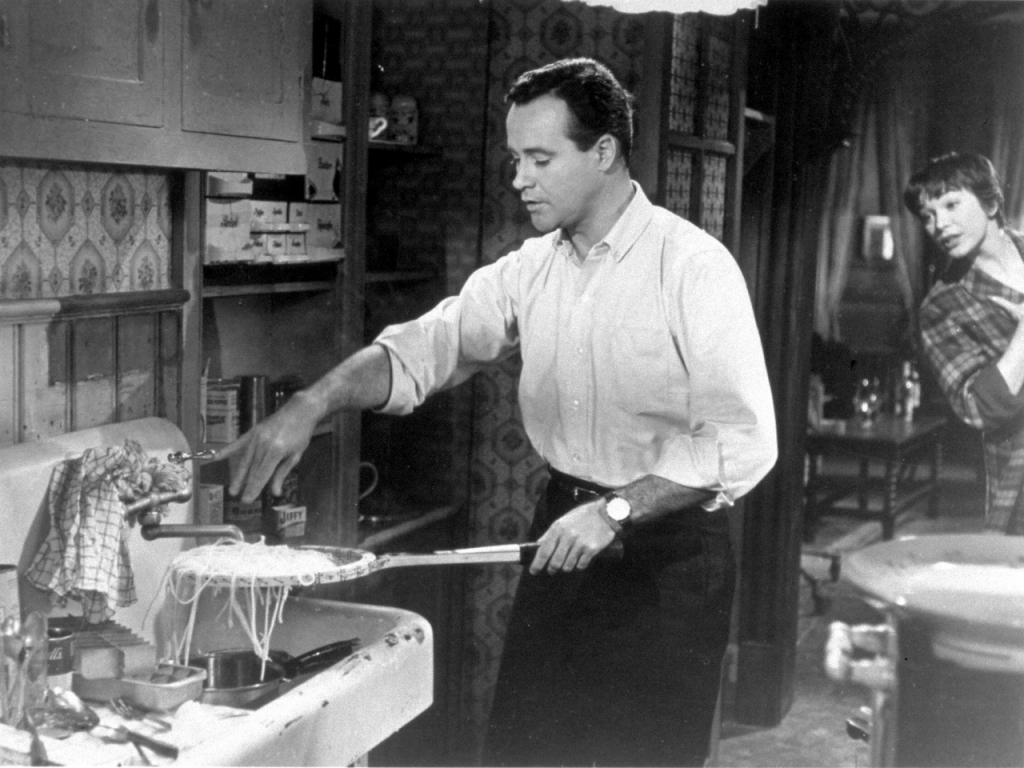
C.C. Baxter (Jack Lemmon) owns a small little apartment in New York, a big city. He works at a small little in an office at a big firm. He's simply a small little man in a big world. However, he has a trick. He books out his apartment to some of his superiors at work as a place that they can bring women back to without their wives knowing. Baxter's superiors, in turn, put in a good word for him at the office. Soon, he finds himself offering his apartment to the top dog, Mr Sheldrake (Fred MacMurray), for his affair with an elevator operator, Fran Kubelik (Shirley MacLaine). Baxter begins to fall for Miss Kubelik without knowing of her affair with Mr Sheldrake. Needless to say, Baxter encounters problems with both renting out his home and his fondness for Miss Kubelik, and their not easy hurdles to leap either.

This was the 60s. Long before saucepans.

I adore Jack Lemmon. I think he was absolutely fantastic in Some Like It Hot and this is also exceptional. That being said, it's a very different role. It's a subtle, refined, and simplistic character. It's also one of the most delightful, charming, but utterly heartbreaking characters that film has produced. Throughout all of C.C. Baxter's tumbles and falls, we can tell every emotion. Every tiny feeling. We can see when he's trying too hard to cover it up. We can see when it's eating him inside. It's an absolutely perfect characterisation and one that fully deserved the Oscar nod it received. the supporting cast are all outstanding too. There's not a flaw among them. Fred MacMurray is a wonderfully unconventional 'baddie'. While nothing he does is illegal or evil, though he is morally questionable, we, the viewer, find ourselves rooting against him and for the girls whose hearts he has broken and for Baxter. And Shirley MacLaine. Not only is she beautiful, she's perfect for her role. Completely ambiguous when it's needed, leaving the audience begging for more right until the credits roll, and even after.

I just really like this shot.

What really makes this film worthy of it's consideration as one of the best movies of all time is its absolutely unbeatable talent for combining genres. Is it a comedy? A satire? A criticism of the capitalist system? A romantic comedy? A drama? It is all of these things and more. It is, at risk of using a word thrown around too losely nowadays, a masterpiece. I found it captivating and dripping with charm, wit, and heart. I want to watch it again and again. Filmed in black and white, it may scare people away due to its age. Rubbish. This is how films should be made; colour makes no difference. Music is rarely used unless we see someone put a record on on-screen. I, personally, like this touch. It makes the soundtrack feel even more directly related to the film.

I could go on for hours about how much I enjoyed this film. It's rare that I come across a film such as this and want to watch it again straight away. A delightfully charming and clever piece of cinema that shows other films how they should be. While it is mostly light hearted, it looks deeply at love, greed, betrayal, and politics. It has everything  a film should have and leaves you wanting more.


Best Bit? Can I say all of it? Beh. Any scene between Baxter and Fran early in the movie. Touching, light hearted and delightful. Still too general? Fine. When Baxter makes spaghetti on a tennis racket. Had me in stiches.