Tuesday, 15 July 2014

Apocalypse Week 2: Earth Egg

The end of the world has been predicted, feared, predicted, mocked, and predicted again for all of time. The world of cinema has attempted to portray the fate of the earth time and time again. For decades film makers have considered the ways in which doom day may come. Yesterday we looked at nature destroying the Earth. Today we look at mankind and the things they would do for knowledge. This is 1965's Crack in the World.

Dr Stephen Sorenson (Dana Andrews) and his wife Maggie (Janette Scott) are on the verge of something incredible. They are drilling a hole through the Earth's crust to allow them to harness the vast amount of energy at the Earth's core. They want to use an atomic warhead to break through the last layer to the magma core. However, Dr. Ted Rampion's (Kieron Moore) research shows that the explosion could cause shattering devastation to the Earth, literally. As Sorenson explains, if Rampion's theory is correct, the effect on the Earth's crust will be much like a hammer hitting a window. But Sorenson gets the approval for his missile and goes ahead with the project, with what seems to be excellent results. That is until earthquakes start happening across a particular fault line and causing a crack in the world that could end life as we know it. Can the scientists stop the destruction?

Smashing demonstration Doctor!

There are a lot of words beginning with P that could describe Andrews' Sorenson: persistent, power hungry, peculiar. On their own, none are quite correct, but together they form a reasonable summary of Andrews' portrayal. His thought process, often down the lines of 'How many men get the chance to turn the page of history?', shows his ego, and explains his depressive mood towards the end of the film as his dream shatters. Otherwise, the acting has little to praise. Scott's Maggie seems at first to be a strong female character, describing herself as a scientist to an elevator full of men, but as the film progresses, Scott adds little personality to Maggie that is not influenced by her fondness of Ted or Stephen. There is nothing particularly memorable about any performance given.

This is why crack is bad, kids!

Like When Worlds Collide, Crack in the World has not aged well. The special effects towards the end of the film as the destruction reaches its climax is visually exciting, though not overly convincing. A train being thrown from its tracks is a little too obviously a model train and the scene the precedes the accident is tedious to say the least. As the train heads towards disaster, Maggie and Ted try to warn the driver of the crack by driving alongside the train and yelling. The driver merrily waves back for far too long, like a robot stuck on a waving function. It is simply one example of ridiculous and questionable elements of the film designed to attempt to make the film more alarming with the loss of human life but in completely unrealistic scenarios. The dialogue never really hits any form of stride after the strong opening. Once the disaster is actually under way, most characters become two-dimensional and the leads become dull with the exception of Sorenson, who locks himself away underground to finish his work.

A weak film. As a summary, the plot is simple enough to work, but the there are too many moments of weakness scattered around many elements of the film, from the dialogue, to the acting, to the overly cheesy score underneath lengthy shots of dramatic faces of worried scientists.


Best Bit? The opening of the film. Sorenson demonstrates the effect his weapon will have on the Earth's crust be slamming a hammer through a glass pane, and then burning through a separate pane with a burning poker to calm the concerns of the men in the room.

Monday, 14 July 2014

Apocalypse Week 1: Planet Pinball

The end of the world has been predicted, feared, predicted, mocked, and predicted again for all of time. The world of cinema has attempted to portray the fate of the earth time and time again. For decades film makers have considered the ways in which doom day may come. Our first film, from 1951, is one of the few from the era not based around the extinction of humanity through nuclear war. This is When Worlds Collide.

A star called Bellus is on a collision course with Earth. Orbiting that star is a planet named Zyra and upon confirming the awful truth of the collision course, Dr Hendron (Larry Keating) decides there is only one solution. They must build a ship to fly some members of the human race to Zyra before the destruction of Earth. A rich wheel-chair bound man called Stanton (John Hoyt) puts the money forward for Hendron's plans in return for a space on the ship and so the deal is done and Hendron and Dr Tony Drake (Peter Hanson) begin to plan their species survival. The ship, having only enough room for necessities and forty people or so, is under construction and the workers enter a lottery to see who will be allowed on the ship with the already chosen few including a morally conflicted pilot named David Randall (Richard Derr) who does not believe he has earned a spot on the flight. Bellus passes close to Earth causing natural disasters to happen over the whole Earth and the race to finish the ship is on.

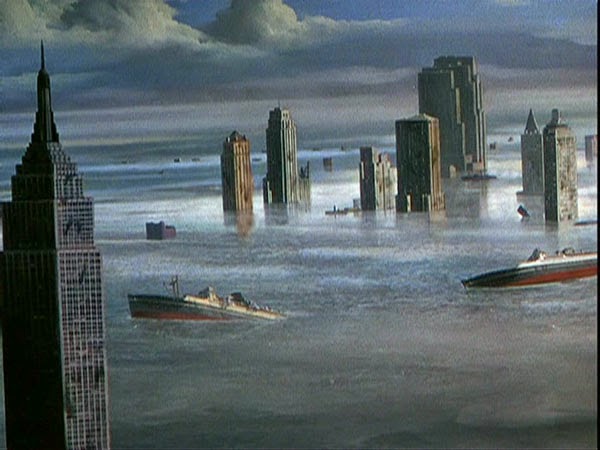
Water a way for New York to go...

Rudolph Maté's disaster film rattles along with a focus on his characters leading up to the end of the world rather than the Earth's destruction. Keating's Hendron is focused on carrying on human kind after Bellus hits Earth, and perfectly so. He is powerful, stern, and overwhelmingly caring at the same time. Next to Hoyt's angry Stanton, he seems like a saint, if not a little obsessive. He is the star of the film. Much like the rest of the film, the acting style from the other performers is a bit dated. Women lacking much personality, men arguing quickly and with little reasoning. Perhaps it is more a script based error, or the 89 minute runtime cutting out important character thought processes, but the film occasionally seems to jump wildly from one conclusion to another. However, there are some charming scenes with wonderful sections of dialogue, nearly all of them involving Keating's arguments with Stanton.

The new Thorpe Park ride is out of this world.

Whilst the film is dated, it never stops being enjoyable. There is a glorious feeling that comes from the merry optimism from a pre-moon landing America. Spaceships can be shot into space off of a roller coaster track and stars will not burn the atmosphere of Earth until very very close. As Bellus becomes close to Earth, the audience are treated to a montage of disasters (mostly pinched from other films) that show the oncoming end off the world and it is the only scene that really shows any destruction or effect of the star's passing, but it does it effectively. Waves ripping through a New York street, fires over an oil field, the normal. And in the closing stages of the film, a more powerful message becomes evident. The men who have not been selected for the flight riot and the question is raised: who decides who lives and dies? How would we, the audience, react? A minor moral underlying to an otherwise straight forward plot.


A nice, if not dated, view of the end of the world at nature's hand. Scientifically dreadful, but enjoyable none-the-less. The short runtime ensures it never drags, even if does sometime make large leaps forward.

Best Bit? The montage of the disasters followed by a the touching rescue of a boy stuck on a roof  in a flood (and the dishing out of supplies to survivors, though they won't survive for long, will they?)

Friday, 11 July 2014

Coming Soon: Apocalypse Week

Some of you may remember Vietnam Week - A week in which I reviewed seven Vietnam war films in seven days. Well I wanted to do it again, so hang on to your hats folks! Monday will mark the beginning of my second set of themed reviews. Vietnam Week, move over. Welcome, Apocalypse Week.

I will be reviewing one film that depicts the end of our world as we know it every day next week. But this time there is another layer. Unlike the Vietnam war, the end of the world has been presented in film since before the 1950s. In order to do a good scope of films, I will be picking one film from every decade from the 1950s onwards.

Any apocalyptic films I have already reviewed will be linked on the main Apocalypse Week page along with the films reviewed next week as they come.

Any suggestions? Recommendations? A particular apocalyptic film from the last 60 years that you feel should be included? Let me know and I will check it out and possible include it.

Enjoy next week! It could be our last.


Wednesday, 2 July 2014

Ghost Mirror, Ghost Mirror on the Wall

Horror is a constantly slammed genre in the universe of film. Famous for blood, gore, cheap effects, you name it. So why do people still attempt to make horror films? Is it even possible any more to make a good horror film? Today's film will try. This is Oculus.

A young woman, Kaylie Russell (Karen Gillan), wants to clear her little brother Tim's (Brenton Thwaites) name from the murder of their father, Rory (Rory Cochrane), when they were kids. Kaylie is insistent that there is a dark supernatural force attached to the mirror their father had in his office and eleven years later, when Tim is released from the mental institution he has been in, she sets up an experiment to prove that the mirror is evil, her father is innocent of the murder of her mother, Marie (Katee Sackhoff), and Tim is innocent of the murder of their father. As the past collides with the present within the house in the form of flashbacks and hallucinations, we see the events surrounding the murders eleven years earlier with a young Kaylie and Tim (Annalise Basso and Garrett Ryan respectively) struggling with the strange events in the house. But how strong truly is the mirror and Kaylie's plans to expose the truth really work?

No, guys, you have to face the front.

With a huge television star gracing the big screen several times in the upcoming year, there will always be a nagging fear that Karen Gillan, looking much the same as her famous Amy Pond, will make her films seem more like extended episodes of Doctor Who. It is a nagging fear, but a completely ungrounded one. Gillan holds her own with a strong American accent, a darkly entertaining, yet brutal, way of talking about the mirror, and an obsessive personality, completely focused on proving the mirror's evil. Thwaites is a powerful companion too, crossing so brilliantly between fear, bravery, and confusion of his reality. His uncertainty as to what is real is the film's strength in a nutshell; as the protagonist, if he cannot tell what is reality, how are the audience ever expected to. Cochrane and Sackoff also put in solid turns as the parents who are falling under the mirror's evil control. There is something endlessly ominous about loving parents having a terrifyingly strong and quiet presence in the fit of a murderous rampage. 

Seriously?
Does no one in this film know how to use a mirror?

The first real gem of Oculus is the child actors. Annalise Basso and Garrett Ryan are simply incredible. Often occupying the screen alone, the pair do not just fill the space, they control it. They are also giving plenty of chances to prove their acting abilities curtsey of a fantastic script by Jeff Howard and Mike Flanagan, the latter of which also directed the horror. Oculus' second gem is the ingenuity of the plot. There is nothing overly original about a ghost mirror, or possessive spirits, or even vengeful young adults, and yet Flanagan has come up with something fresh and exciting. Perhaps it is the ambiguity of the ending, forcing the audience to question and make up their own minds on the extent of the mirror's power, or maybe it is the way the past and present dance with each other, darting in and out of rooms, interlinking together to create a fluid and exciting narrative. Either way, Oculus has people talking, arguing, and debating about all aspects of the film from the mirror's powers, to how they as individuals would beat it. A true achievement. 

Flanagan's direction is confident and dark. There is a morbidity about it and yet there is still plenty of lighter entertainment too. Most successfully though, it causes the audience to question what they see. This is not one of those horrors that just wants to shock its viewers with cheap scares, it wants to engage them, make them uncomfortable, and creep them out. Oculus has weight that a lot of modern horrors lack and has thrown Flanagan into the horror spotlight. A frightful joy. 


Best Bit? Kaylie and Tim are outside the house looking in at themselves preparing to kill themselves with one of Kaylie's self-timed 'precautions'. Are they outside or inside? Is the mirror trying to draw them back in or keep them exactly where they are - at death's door? The moment sums up how the mirror plays with the mind and leaves the audience with an unsolvable dilemma.


Wednesday, 11 June 2014

Sex, Drugs, Neon Colours

Female Disney stars often end up being the centre of a media circus due to some controversial act, photo, or video that shows them as more than a slave of the House of Mouse. Most notably is probably Miley Cyrus. But let's not forget Vanessa Hudgens nude photo scandals, or Selena Gomez' relationship with Justin Bieber. But the best way to shut the critics up? Embrace your life as a performer just as Miley Cyrus did with her music, or Hudgens and Gomez did with today's film. This is Spring Breakers.

Four college girls have a simple dream: to go on Spring Break. Faith (Selena Gomez), Candy (Vanessa Hudgens), Brit (Ashley Benson), and Cotty (Rachel Korine) want to party in Florida with all of the other students but even with gambling and savings, they just cannot find the money to go. That is until three of the girls come up with a plan to make some extra dough by robbing a local restaurant. But when there is a will, there is a way, and the girls head of to the sunshine state to party hard, have sex, take drugs, and party harder. They want to discover themselves and have a spiritual revolution, if the trouble they get into along the way does not stop them, or if a strangely helpful rapper/drug dealer named Alien (James Franco) does not get them in more.

If she gets a paper cut, that would blow.

Spring Breakers is a neon coloured acid trip into the wasted youth of America. The four girls are little more than empty shells of characters spurred into a dark world filled with bright colours and drugs. Franco's Alien is a grotesque figure that somehow manages to charm his way into being likeable despite silver grills on all his teeth and guns on all his walls. Gomez's Faith is probably the most three-dimensional of the college girls, struggling with her own faith and how all this partying will affect her spiritually. She also acts as some form of repetitive narrator whispering down the phone about finding herself whilst the same bright, almost hallucinogenic shots of the girls partying flash over the screen for the first 40 minutes of the film.

After the partying the girls needed arrest. 

Aesthetically and artistically, the film is gorgeous. Like a drug induced journey into the mind of any American college student, Spring Breakers combines light with dark in both explicit and subtle ways. The highs of drugs and drink combined with the violence and harassment that comes with the lows of the party lifestyle. Pink balaclava clad women in bikinis with guns on a electric yellow pontoon are but one of the powerful eye catching colour combinations that director Harmony Korine works with in the film. It is just a pity he did not spend as much time building a better narrative for his films. While it is all very pretty to watch, the end result is unsatisfying. How many times in 90 minutes can James Franco drone 'Spring Break Forever' underneath clips of naked women that are seemingly taken from a Girls Gone Wild video from the 90's. Some may argue that there is a deeper meaning to all of this; that the emptiness is representative of the empty, superficial nature of today's youth. But this is no Tree of Life or 2001: A Space Odyssey. This is a visually stunning piece of cinema that lacks soul.

The phrase 'diamond studded turd' springs to mind when regarding Spring Breakers, but that is possibly too harsh. The film is entertaining enough to not feel like a waste of time, but really, with all the repeated shots and mindless nudity, it feels like the whole thing could be shortened to a powerful short film, rather than feature length neon art.


Best Bit? Well for some it will undoubtedly be the gratuitous nudity but there is something extremely, and darkly, enjoyable about the film's finale.

Thursday, 10 April 2014

Out Of the Oscar Coma: Short Reviews

Every year after rocketing through all the films I can on the Oscar ballot, I slip into an 'Oscar Coma'. I avoid too many films to catch up with some television instead. This means that very little happens on this blog. But do not think I have been sitting by doing nothing. To prove that, have some small reviews to keep you all going.

Frozen

The latest Disney animation about two princesses, Elsa (Idina Menzel) and Anna (Kristen Bell). Elsa has magical abilities that allow her to conjure ice and snow. On the day of her coronation, Anna gets engaged to Hans (Santino Fontana), a man she has only just met, and Elsa cannot hide her powers any more. She is run out of her kingdom by her own people and hides away in a castle of ice. With the help of ice loving Kristoff (Jonathan Groff) and his reindeer Sven, Anna goes in search of her sister. There's also a snowman called Olaf (Josh Gad) and some trolls who have raised Kristoff.


Whilst the animation and concepts within the film are incredible, the rest just is not quite there. There are plenty of minor issues that could easily be solved but instead leave questions unanswered. With songs thrown in with little reasoning - the trolls tell us that Kristoff is a fixer upper, a pointless song - and with a plot that rattles by with the speed of a cheetah, the film cannot afford to waste time with such meaningless songs. It is not that the songs lack quality, they lack value. Similarly, the rest of the film is enjoyable but entirely superficial. It ticks all the boxes on the mainstream check list - attractive protagonists, catchy songs, visually engaging animation, silly jokes - but it is all surface level. With minimal plot, the most character development happens in one song: Do You Want To Build A Snowman. After this, what could have been bold statements by Disney about sisterly love, anxiety, being who you are, and the dangers of judging others fall away into the distance and become dots on the horizon. But it is fine because the trolls are adorable, right?

Catchy, enjoyable, but lacking in any real depth. So much potential in the first twenty minutes. Such a small outcome.

Best Bit? Do You Want To Be A Snowman is one of the most moving openings to a film in a long time. Two entire characters summed up in a couple of minutes.

The LEGO Movie

Another big animation, this time coming from Warner Brothers and is completely made from LEGO. Not stop motion, mind - computer animation of LEGO. Emmet (Chris Pratt) is a perfectly average LEGO man when he gets mistaken for the most extraordinary person alive. He gets roped into a society of 'Master Builders', the LEGO characters who can build away from instructions. These people include Batman (Will Arnett), Abraham Lincoln (Will Forte), Vitruvius (Morgan Freeman), and the girl who discovers Emmet, Wyldstyle (Elizabeth Banks). However, Lord Business (Will Ferrell), the evil tyrant that rules the LEGO world, forbids the making of LEGO structures without instructions and has evil plans to solidify his universe with 'Kragle'. Emmet, as the 'Special' must use his abilities to stop him. Unfortunately, he does not have those abilities.


The LEGO Movie created a stir prior to its release with its hilarious trailers featuring every character under the sun. It does not disappoint. Scattered with laugh out loud moments but between, the chuckling will not rest. Highly inventive, literally using one of the world's most popular playtime toys as the driving force of a whole plot. There is no way you will not find yourself wanting to dig out your old LEGO box when the credits roll. Maybe it is a huge advertisement, but it never stops being entertaining for the entire family. Feel no shame watching it without kids, this film is made for everyone. And guaranteed you will not be able to get Everything is Awesome out of your head for weeks.

A strangely philosophical escape from reality into a childish sense of joy. Hilarious and gloriously entertaining.


Best Bit? The meeting of the Master Builders in Cloud Cuckoo Land. Hilariously constructed with cameos from your favourite characters and voice actors alike.

The Act Of Killing

Joshua Oppenheimer's Oscar nominated documentary asks government protected Indonesian killers who committed mass murders 50 years ago to reconstruct their killings in any film genre they want. This includes gangster films, art films, and musical numbers. The result is a brutal truth exposing the atrocities that happened decades ago in a country that flies relatively low on the Western World's radar. Do not be mistaken by the pastel colours on the poster. It is far more  disturbing than that, a point which the trailer makes very clear.


This is one of the finest documentaries in years. Challenging, powerful, shocking, and hard to watch. Anwar, the killer we follow, is a horribly likeable character, dancing on rooftops whilst describing the brutal ways he tortured and murdered people. Perhaps more disturbing is the idea of him being hailed as a national hero for his 'crimes'. As he says himself, crimes are decided by the winners and he is a winner. What The Act Of Killing does is open the viewers' eyes to the darkness in the world, and the horrors of seeing your own dark past in front of you.

Hard hitting and eye-opening. A masterpiece.


Best Bit? Is there a best bit in something made to expose darkness? There's certainly something heartbreaking about the end. 

Saturday, 1 March 2014

Evil Nuns

What happens when you put M and Alan Partridge on a journey into the past? Well who knows, but this is as close as we will get for now. This is Philomena.

Based on a true story of a disgraced politician, Martin Sixsmith (Steve Coogan) who, when he gets the sack, looks back at doing some journalism work. What he stumbles across is a human interests piece in the form of Philomena (Judie Dench), a little old Irish lady, who had her child taken from her by the nuns that were her guardians. The article becomes a thrilling thought to Martin. Evil nuns, a searching mother, a lost child, a tale spanning 50 years. It has everything needed for a successful story and so the pair set off, first to Ireland and then on to America to find the lost Anthony. But the tale is not simple, having to fight against dead ends and unhelpful sources, but can the two find what they are after - a reunion between mother and son?

'Bond, you look different'

What happens when you combine two of Britain's finest talents in a film together? Philomena, and it is splendid. Steve Coogan, who also wrote the film with Jeff Hope, does a wonderful job portraying Sixsmith as a cynical, world-weary fellow who just wants his story. Well, until half way into the film when we see his human side develop a little bit more. And Dame Judie Dench, the faultless Judie Dench (we will forget Chronicles of Riddick) as the delightful, yet somewhat grating, Philomena. But it is neither part is a solo act; this whole film is about the relationship of the two characters. Philomena, a simple woman with a lot of faith. Martin, a master with words that likes to investigated the complex. The two clash and collide but it makes for a seriously entertaining film. Laughs are often constructed by Sixsmith's annoyance of everything around him, tears are often wrenched by Philomena tugging on your heartstrings. It is a two person show, and by gosh, do they show. 

What a chairful couple.

A truly wonderful script by Coogan and Hope, brought to life masterfully by Stephen Frears. But it is the screenplay that stands out. As previously stated, this is a film about relationships, which are built on communication. From opening to close, there are lines that should be quoted again and again. Some notable moments are often about faith. The question of 'do you believe in God' gets thrown in there, to which Martin rambles for a while and finishes stating that there is no easy answer, then asks Philomena who gives a simple yes. And suddenly the characters are so clear in such a simple conversation, which is the mastery of writing for the screen. A brilliant achievement, and nominated around the board in recognition.  

Listed as a comedy, but still very much a tale told for the heart. It is exceedingly funny, but with enough sincerity that it never loses its power as a strong story.


Best Bit? The pair are in an airport discussing their books. Philomena begins to explain her book. I can guarantee that every audience goer will be able to identify with Martin's face as she goes on about horses. Realistic and hilarious.