Showing posts with label sci-fi. Show all posts

Monday, 14 July 2014

Apocalypse Week 1: Planet Pinball

The end of the world has been predicted, feared, predicted, mocked, and predicted again for all of time. The world of cinema has attempted to portray the fate of the earth time and time again. For decades film makers have considered the ways in which doom day may come. Our first film, from 1951, is one of the few from the era not based around the extinction of humanity through nuclear war. This is When Worlds Collide.

A star called Bellus is on a collision course with Earth. Orbiting that star is a planet named Zyra and upon confirming the awful truth of the collision course, Dr Hendron (Larry Keating) decides there is only one solution. They must build a ship to fly some members of the human race to Zyra before the destruction of Earth. A rich wheel-chair bound man called Stanton (John Hoyt) puts the money forward for Hendron's plans in return for a space on the ship and so the deal is done and Hendron and Dr Tony Drake (Peter Hanson) begin to plan their species survival. The ship, having only enough room for necessities and forty people or so, is under construction and the workers enter a lottery to see who will be allowed on the ship with the already chosen few including a morally conflicted pilot named David Randall (Richard Derr) who does not believe he has earned a spot on the flight. Bellus passes close to Earth causing natural disasters to happen over the whole Earth and the race to finish the ship is on.
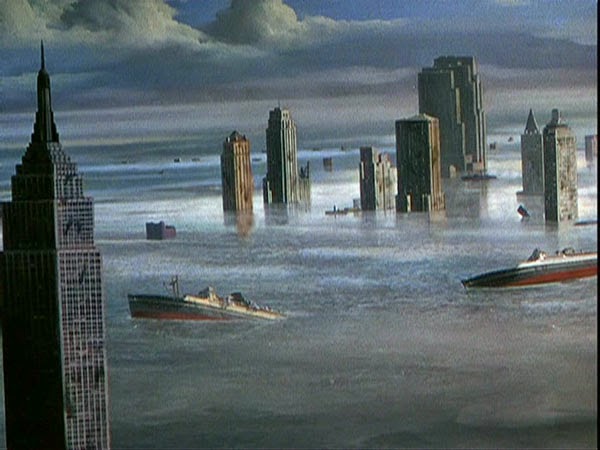
Water a way for New York to go...

Rudolph Maté's disaster film rattles along with a focus on his characters leading up to the end of the world rather than the Earth's destruction. Keating's Hendron is focused on carrying on human kind after Bellus hits Earth, and perfectly so. He is powerful, stern, and overwhelmingly caring at the same time. Next to Hoyt's angry Stanton, he seems like a saint, if not a little obsessive. He is the star of the film. Much like the rest of the film, the acting style from the other performers is a bit dated. Women lacking much personality, men arguing quickly and with little reasoning. Perhaps it is more a script based error, or the 89 minute runtime cutting out important character thought processes, but the film occasionally seems to jump wildly from one conclusion to another. However, there are some charming scenes with wonderful sections of dialogue, nearly all of them involving Keating's arguments with Stanton.

The new Thorpe Park ride is out of this world.

Whilst the film is dated, it never stops being enjoyable. There is a glorious feeling that comes from the merry optimism from a pre-moon landing America. Spaceships can be shot into space off of a roller coaster track and stars will not burn the atmosphere of Earth until very very close. As Bellus becomes close to Earth, the audience are treated to a montage of disasters (mostly pinched from other films) that show the oncoming end off the world and it is the only scene that really shows any destruction or effect of the star's passing, but it does it effectively. Waves ripping through a New York street, fires over an oil field, the normal. And in the closing stages of the film, a more powerful message becomes evident. The men who have not been selected for the flight riot and the question is raised: who decides who lives and dies? How would we, the audience, react? A minor moral underlying to an otherwise straight forward plot.


A nice, if not dated, view of the end of the world at nature's hand. Scientifically dreadful, but enjoyable none-the-less. The short runtime ensures it never drags, even if does sometime make large leaps forward.

Best Bit? The montage of the disasters followed by a the touching rescue of a boy stuck on a roof  in a flood (and the dishing out of supplies to survivors, though they won't survive for long, will they?)

Thursday, 14 November 2013

Space

In space no one can hear you scream... or talk... or do much of anything which is why communication technology is a really important thing when working in space. But what happens when things do not go right and neither screaming, nor talking, nor much of anything can help? This is Gravity.

Up above the atmosphere, Dr Ryan Stone (Sandra Bullock), Matt Kowalski (George Clooney), and the team of the Explorer shuttle are working on some repairs and updates on the Hubble Telescope. They tell stories and fun jokes whilst Stone works hard with the space technology and Kowalski floats around on his jet-pack, enjoying his last mission before returning to Earth. Suddenly, Houston aborts the mission as a satellite that the Russians have blown up has become debris rocketing through space at lethal speeds and the shuttle is right in the middle of its path. Stone is not fast enough and gets separated from the ship, spinning away into the abyss of space. Breathing heavily, fearfully flying, she tries to orientate herself so that Kowalski can catch up to her. What follows is ninety minutes of two astronauts going against every challenge (low oxygen, low fuel, flying killer debris etc) to preserve their own lives.

What's got ya down, Stone?

There may be no sound in space, but there is the opportunity to put in a fantastic with little more than your face and voice and both Clooney and Bullock do just that. There was no use of zero gravity in the production of the film, all the weightlessness is simulated with extremely clever choreographed sequences memorised by the actors. These were sometimes extremely long sequences too, the first scene alone is ten minutes or so without a cut. Bullock should be particularly praised. It is her that the audience build a connection with through the story telling and cinematography of the film, and it is her that is thrown into space alone. She is completely moving as the innocent, newcomer to the world of space, her only crime being over-enthusiasm for her work.  Several times she resigns herself to the fate of the universe before being inspired by Kowalski, or a Chinese lullaby, or whatever. We see the process of a human brain contemplating life's worth with the back drop of a sci-fi thriller through Bullock's performance - often with the smallest visual of her face or just her voice. Clooney gets to do what Clooney does best. A smart, charismatic man, who truly emulates kind arrogance as the mission commander and always puts the safety of Stone before himself. Delightful.

A-door-able. 

Fantastic performance aside, no film such as this would be a success without a stunning technical side. Throughout film history, the most critically acclaimed science fiction films have been just as technically astounding as they have been well performed. Look at 2001: A Space Odyssey, Moon, or even Avatar. Like 2001 and Moon, Gravity puts emphasis on the size of the universe and how small and alone a person can be compared to something that incomprehensibly huge. But unlike those films, Gravity rockets through with adrenaline and suspense at a speed to rival a Die Hard film. Constantly on the edge of your seat as one thing goes wrong after another, continuously putting the innocent astronauts in life threatening situations through no fault of their own. But it is not just the writing that makes this film, it is the way in which we, the viewer, get to experience it. We get put inside the helmet of Dr Stone on multiple occasions and see the disaster as she sees it. We spin with her and are made dizzy and delusional. We are essentially placed in the situation with her through a roller coaster like journey with the camera, enhanced brilliantly by Steven Prices score and the choice of soundtrack. This is a true success by Alfonso Cuarón and will go down in the books as an essential sci-fi.

An emotional, heart pumping, and suspenseful piece of cinema. What else do you expect from the director of Children of Men and the best film in the Harry Potter franchise (Prisoner of Azkaban)? Clooney and Bullock are phenomenal, and the film is a brilliant creation with 3D so perfectly utilised to create the depth of space and the minuscule nature of humans. A must see and one of the films of the year.


Best Bit? There are a lot of cracking moments but a moment that stood out was just after Stone had survived yet another life threatening challenge, she curled up into the foetal position whilst floating in an airlock with the sunlight shining brightly through the window behind her. Why did it stand out? It was the moment that said, this film is more than a sci-fi thriller, this is a story that contemplates life. This is the rebirth of someone who just escaped death. Complex stuff below surface level.

Thursday, 4 April 2013

Darkness.

So the world got a little bit excited when this trailer was released. 23 seconds of video have made people crawl out of their holes, pull on some goggles, and see the light again. Why? They've been waiting nine years for those 23 seconds. Later on this year, we will see the full feature, but for now, lets take a step back in time and see where this all started. This is Pitch Black.

Somewhere, out in space, the transport vessel, Hunter-Gratzner, is carrying 40 passengers suspended animation. One of these passengers is Riddick (Vin Diesel), an escaped convict and murderer who is being moved back to a slam. Away from humankind or even daylight. The ship is travelling in a ghost lane with no stops, and as a voice over from Riddick points out, that leaves a lot of time for something to go wrong. Incidentally, something goes wrong. The captain dies leaving the docking pilot, Carolyn Fry (Radha Mitchell) and navigator, Greg Owens (Simon Burke), to land the ship safely on an unknown planet. As the ship hurtles towards the ground, Fry starts ejecting parts of the ship to lose weight. At the last moment, she tries to jettison the passangers, but Owens stops her. The ship crashes leaving 11 survivors: Riddick's guard, William J. Johns (Cole Hauser), holy man Abu "Imam" al-Walid (Keith David) and three young men he is escorting on hajj, antiques dealer Paris P. Ogilvie (Lewis Fitz-Gerald), stowaway teenager Jack (Rhianna Griffith), settlers John 'Zeke' Ezekiel (John Moore) and his partner Sharon 'Shazza' Montgomery (Claudia Black), Fry, and Riddick. Riddick escapes and the crew become extremely concerned about him s but, along with difficulty breathing, a lack of water, and three suns blazing down on them, Riddick might be the least of their worries. Especially when it seems they are not alone on the planet and the darkness is approaching.

 Face-off... err... Face/hammerhead off? 
Some people believe that everybody is born for a reason. There should be no doubt that Vin Diesel was born to play Riddick. A perfect balance of creepy and cocky that solidifies his persona as a stone cold killer. He steals the show and, apart form a brief voice over, he doesn't even talk for the first half an hour. But in that time, we see him escape twice, get caught twice, and fashion a knife out of bone in order to, what appears to be, minor hairdressing. Hmmm. His performance, alongside the will-do-anything-to-survive attitudes of Burke as Hauser as Johna and Mitchell as Fry, really creates the atmosphere of the film when the low budget-ness of everything can sometimes jar. At the start we are introduced to all the survivors just through looks but all of the actors develop their characters individually and create a wonderful ensemble performance that leaves you to decide who you like and who you would like to see die. Fantastic performances all round, but, again, it is Vin Diesel who steals the show. No wonder he got two sequels named after his character.

And next on Literal TV: Stars In Their Eyes


Pitch Black is a wonderfully cut together film. Speedy editing that captures the true essence of the movie as it develops. The first half is played almost like a sci-fi horror with Riddick appearing in the background of shots or being inter-spliced with shots of what is going on elsewhere with the survivors. The second act is more steadily paced with building suspense and tension as the darkness closes in on the characters. Not only this, but the writing keeps the character development believable and understandable, something that can get lost with big budget sci-fi thrillers. Issues rise with the 'pitch black' landscape often being reasonably well lit, but as irritating as it may be for the film pedants among you, it does not take away from the merits of the film. Wonderfully filmed otherwise; the small but bright lights beautifully penetrate the dark surroundings in the latter half of the film, a delightful, and somewhat creepy contrast, from the exciting and bright first half. 

A truly enjoyable sci-fi that contains drama, thrills, creeps, and appeals to every instinct in the human body. Vin Diesel in his perfect role (though I still await a Time Splitters: Future Perfect film with him as Cortez) and a deeply satisfying plot with some great lines. ('You said it was clear!' 'I said it looked clear.' 'How does it look now?' '... Looks clear.') A thoroughly enjoyable watch.


Best Bit? The lighting, suspense, and general action in Riddick and Johns' fight is a particular highlight of the film.

Watch this spot for a review on the sequel: 'The Chronicles of Riddick.'