Showing posts with label film. Show all posts

Wednesday, 17 October 2018

1001 Movies - Downfall (Der Untergang)

The largest loss of human life in modern history can almost be directly attributed to one man. A man that instructed the killing of Jewish people by the thousands and started a war with such devestating consequences, we still feel them today. Adolf Hitler was guilty of atrocious crimes against humanity yet was, without doubt, one of the pioneers of political celebrity. He understood the power of the filmed image and even produced astonishing, well crafted, films to push his agenda. How fitting, then, that the medium of film is also one that weakens him and his memory.

Whilst many may only know it for it's famously parodied bunker scene, in full, Downfall portrays an unsettling balance, a likely truth that we would rather not believe. It draws out Hitler the monster but also, even more so, Hitler the man. A man that was kind to his secretaries and loved his dog. A man that suffered from several health issues, physically and mentally. A man that felt the stinging arrow of a friend's betrayal penetrate the vulnerability of his emotional armour. All this to remind us of the horror that it was not, in fact, a monster that thought Jewish people were a plague on the face of the Earth, but a man.


It takes a truly brilliant screenplay to portray Adolf Hitler sympathetically, but that's what we have here. We hear him discuss his plans for the new Berlin, a hub of culture and art, and its not the embodiment of evil that we've come to think of when we think of the Nazi party leader. He's gentle and kind, frail and ill. But he's also madly paranoid, quick to anger, unrepentant in his treatment of those that disappoint him and proud of his headway in the annihilation of the Jewish race. Bruno Ganz plays the Führer constantly on the edge of this kind fragility and mania to make him unpredictable, adding menace to his meltdowns but also a softness in his quieter moments.


It's a delicate balance and one that's needed. The audience need to care for Hitler to keep them in the story, they have to be emotionally involved with his titular downfall, but also distant enough that they're not saddened by it. At the end of it all, Hitler's death is human and deserved. There's no superhuman death matching the superhuman evil, just a bundled up body in a blanket (note - something that the Harry Potter books nailed with Voldemort's death and the films completely missed. A helpful point to see why the slumped body is so effective in the narrative of Downfall) and that's it. After all he seemed to be, after the devastation he instigated, after the hatred he fuelled, here he is: a lifeless lump doused in gasoline to be burned by his final remaining followers.


Do not be mistaken when I describe the treatment as sympathetic - there is nothing here to suggest Hitler and his cohort are redeemable. The mass suicides, family deaths, child soldiers, and violent anti-semitism are all presented here as brutal reality and there's no pretence that the war produced anything positive. But we have to see the humanity of the great dictator to be reminded of the painful truth that it wasn't a supernatural evil that inflicted these terrible events on man, but man itself.

TRAILER:


Wednesday, 3 January 2018

The Greatest Showman


Phineas Barnum (better known as P. T. Barnum - played by Hugh Jackman) is a tailor's son - mistreated, penniless, and dreaming of better things for himself, including a life with Charity (Michelle Williams), the daughter of a wealthy client of P. T.'s father. Seeking to change his fortune to give Charity the life of her dreams, Barnum sets about making his fortune with a museum of curiosities, adapting it slowly into a hugely popular and increasingly controversial circus of oddity performers such as a bearded lady, a tattooed man, and a dwarf soldier. But as the circus becomes ever more renown but at the same time more ridiculed, Barnum teams up with Philip Carlyle (Zac Efron), a theatre producer, and sets his sights on a higher class of audience.


The Greatest Showman is a passion project that took seven years to take to the big screen that has produced some of the most inventively staged and filmed musical set pieces of the last 20 years. It immediately bursts into life straight from the Fox logo with a silhouetted ringmaster prancing and dancing his way through the greatest show whilst singing at the top of his lungs to a percussive beat that will make you jam out in your seat; it's clear from the off what sort of musical you are in for. With contemporary influences poured onto lavish ensemble numbers, The Greatest Showman's greatest strength, quite appropriately, is its showmanship - its marvellous spectacle. Teaming powerful voices like Hugh Jackman and Keala Settle with Oscar award winning songwriters Benj Pasek and Justin Paul and topping it off with choreography by Mathieu Leopold, The Greatest Showman dazzles, astounds, and brings joy through its big numbers.


The problem with this is that the narrative falls victim to a lack of detail, a lack of care. A story of showmanship is sold with showmanship, but much like P.T. Barnum's true life ventures, there's an element of fraudulence here. So much is expended on the set pieces that a huge amount of what is in between is shallow and lacking in substance. The stars of Barnum's circus, his critics, and his colleagues are all superficial creations, existing without backstory or depth beyond the most surface elements. Major plot points are skimmed over and the audience are expected to just accept the world with which they are presented but it leaves a certain hollowness to the whole thing. It's a pity that the passion that went into getting the film made (see videos from the workshops and the B-roll footage for evidence) couldn't make its way onto the screen.


It could be argued that what La La Land (the songs in which were also penned by Pasek and Paul) lacked, The Greatest Showman has. It has flair, it has style, but it lacks the substance of it's Oscar dominating peer and that's the difference. It could be put down to rookie director Michael Gracey going through some teething problems in directing his feature film though the influence of his career in visual effects is not lost here. The film is beautifully shot and edited and the narrative, or what is there, is brilliantly emphasised through some digital trickery and imagery and smooth scene to scene transitions. It never drags and it is never unenjoyable.

One of the truest movie musicals in recent cinematic history. It's no Sound of Music but it is a heap of fun expressed through a impressively dominating production design and while you'll want to watch the songs over and over, the overall product is missing the definition that could have made it the greatest show. 

Wednesday, 23 August 2017

OJ: Made in America


Documentaries are some of the most under appreciated works of film out there. It’s not easy to take non-fiction subject matter, cram archival footage in, and jump between talking heads and make it is an engaging as any good thriller out there, but the best ones do just that. I’m not talking here about the ones with a charismatic guide to take us through what’s happening (like Super Size Me, Catfish or Fahrenheit 9/11), I’m specifically talking about those that let interviews and the events tell their own story (see Blackfish for one example). Today’s film is not only a record breaking, Oscar winning endeavour, it also tells the story of one of the biggest rise and falls in American history. This is OJ: Made in America.

We’ve all heard the name OJ Simpson, but do we all know who he is and what happened to him? OJ: Made in America details the the incredible rise and the even more spectacular fall of one of the most astonishing Americans to ever walk the planet. Following OJ from the ghettos of California, to the heights of the National Football League, to a prison jumpsuit in Nevada, the documentary clocks in at just under 8 hours but was sensibly separated into five meticulously structured parts. Focusing on his football career, his fame and fortune, his darker violent side, the trial of the century, and OJ’s life post trial respectively, the documentary breaks down the narrative of OJ’s life beyond the court room. Whilst other big players in popular culture are also focussing on the judicial phenomenon that was the trial (see American Crime Story: The People v OJ Simpson), OJ: Made in America paints a riveting bigger picture of racial injustice in the USA, of a harsh and violent LAPD, of the American justice system, and of our cultural obsession with celebrity status. It is more than a biopic, it is an analysis of a broken and divided society. 


Where OJ: Made in America really achieves is in the way it builds information to culminate in the biggest impact. Talking heads of friends, family, locals, jurors, and police officers amongst others are introduced with little to no context. Mark Fuhrman in interview, for example, offers comments on the Rodney King riots and Nicole Brown’s abuse calls before the documentary reveals his involvement in the case as a racially abusive liar, but it also gives him the opportunity to defend himself. Information is revealed when it is important to the story that director Ezra Edelman is trying to tell, like he is presenting the case in court himself. He allows all sides to have their say on the case and on OJ and the racial divide in America in general. It creates constant drama, suspense, and intrigue and even eight hours in you will want to keep going and hear more. 


Its more important for Edelman to tell the story of America than it is of OJ, thus the tagline for the feature: ‘Made in America’; that’s the real heart of the documentary. Whilst other documentaries on OJ have tried to critique the evidence or find alternative theories, Edelman explains how we ended up in that court room and how the country was so divided on the verdict. It’s painful to watch at times, refusing to shy away from the gruesome. It is the mark of a director who has something important to say. Whilst 13th made similar comments on the state of racial divide in America, OJ: Made in America isolates a specific example that the world is already aware of and bleeds every ounce of contextualising information it can out of it to drive home its point and focusing on such a renowned and particularly charming and popular figure in American culture adds to its appeal over the it’s more evangelical contemporaries. 

OJ: Made in America taps into the true-crime zeitgeist of Making a Murder and Serial but it is shocking in a different way. This documentary isn’t just exploring a potential wrong verdict. It’s very real; the issues it presents are those that our world knows and experiences still. It is not an isolated incident. One part sport movie, one part rising star story, one part race documentary, and one part crime thriller, OJ: Made in America is a rollercoaster and it may be uncomfortable at points but you won’t want to get off.

Tuesday, 22 November 2016

Jaws: The Female Edition


Back in 2010, Ryan Reynolds starred in a particularly good claustrophobic thriller called Buried where he was trapped on his own for 90 minutes and survival seemed unlikely. Now, in 2016, his wife is doing a similar thing. This is The Shallows. 

On a travelling holiday, Nancy (Blake Lively) finds herself on a beach that her late mother visited many years before and the beach is home to one of the most phenomenal surfs around. Grabbing her board, Nancy hits the waves, makes some friends, and catches some waves. As the sun begins to set she decides that after the next wave, she will call it a day. That is, until a great white shark knocks her off her board, bites her leg, and leaves her stranded on a small rock with no rescue in sight. With the tide against her, and having invaded the shark's territory, she will have to get inventive in order to survive.


Solo movies are hard work. The lead performer has to be captivating enough to hold the audience's attention between the action and engaging enough for us to care about them when danger approaches. If you fail in this respect, the film will instantly fall flat. Fortunately, Blake Lively is in fine form. She's smart, strong, and resilient, and whilst the filmic landscape around her may lack clarity,  she performs with all of the conviction required of a leading role. In this day and age, it is so crucial to portray women in a way that does not treat them as secondary to men and if The Shallows has one major success, it is Blake Lively. Whilst some of the early shots are not dissimilar to soft-core pornography, as the film progresses Lively overpowers the male gaze of the camera. Not only does her character, Nancy, fashion her own tourniquet out of a wet suit, she also demonstrates a far greater survival instinct and understanding of her surroundings than any of the men that appear throughout the film.


One part 127 Hours, one part Jaws, but not quite living up to the standard of either,  The Shallows struggles to balance realism or logic with the story the film makers want to tell. Whilst the action is consistently exciting and suspenseful, characters' reasonings get lost at sea. From inexplicably located flare guns to straight up strange decision making, from disappearing dead bodies to never-turning tides, the film suffers from a sloppy approach. A few extra hours editing the script and a bit more focus in shooting and post-production would have helped hugely. The essentials of a great film are all there but it feels like they've been torn apart by the film's aquatic antagonist and messily pieced back together by Jaume Collet-Serra, the film's director.

A sloppy script and a lack of care has left The Shallows feeling a bit washed up. It is not beyond redemption - the keen survival film fan will find plenty to enjoy - but for the rest of us, the film is little more than shallow entertainment.

Saturday, 15 October 2016

Dead Dan


Sometimes in life, there are things that are difficult to comprehend and events that are almost beyond words. Today's film is one of those occurences. This is Swiss Army Man.

Hank (Paul Dano) is at the end of his tether. He is marooned on an island with no food, nowhere to go, and no sign of rescue. The camera pans down a rope to his face, a noose fastened around his neck, and he surveys the hopelessness of his situation. Then just before he kicks the stool out from beneath him, he notices a corpse (Daniel Radcliffe) on the beach which is passing wind powerfully enough to propel it through the water. Cue an ingenious plan to use the corpse as a jet ski and as Hank hurtles forward on the corpse, the narrative follows suite. We follow Hank and the corpse (later named Manny) as they discover new things about Manny's exceptional body and then bound, roll, drag, and fart through the forest trying to find civilisation; the results are spellbinding.


It is hard to know where to start with Swiss Army Man; there is something special and unique about it whilst also being hugely referential with massive pop-culture influences. It seamlessly blends together crude comedy and heartfelt moments that are exceedingly touching. Dano, known for his strength as a troubled individual (Little Miss Sunshine), really shines here. This is, after all, his journey and we instantly captivated by his story. He is the worm and Radcliffe's Manny, with his limitlessly skilled body, is the hook. Together, they drag you into their tale of friendship, fellowship, of life and death. Radcliffe's performance too cannot be understated. This is one of the finest physical comedic performances in years. The strength of the two leads may even force you to shed a tear of sadness, and they are guaranteed to bring on fits of laughter.


Swiss Army Man is gloriously grotesque but disgustingly delightful. Chuckles turn to belly laughs, belly laughs turn to tears. For a film about a farting corpse that wants to understand pooping and masturbation, Swiss Army Man is surprisingly philosophical and thought provoking. Veiled beneath the crude humour is a deep analysis of societal norms and the nature of life and living and, strangely enough, it is almost impossible to imagine a better vehicle for the topic at hand. Directors Dan Kwan, and Daniel Scheinert take films like Terrence Malick's The Tree of Life and, along with their superb script, drags them through the digestion track of cinema and excrete something magical and special. With a powerful and moving acapella soundtrack, often originating as diegetic singing, the film overwhelms the senses in the best way possible. It is hard to imagine anything like Swiss Army Man  existing again and it's difficult to recall anything like it existing before. 

There is something special here. It is stupid but intellectual, crude but beautiful. Whilst some have found the ending a bit jarring, the journey more than justifies it. You have to see it to believe it.


Saturday, 26 September 2015

Scary Saturday: Bad Book

Recently, I discussed the successes of certain horror films and what makes a 'good' horror (the article can be read here). Today is a day dedicated to some of the modern examples of the genre. First up is a film that came out of the land of Australia and took one of the oldest fears and gave it a little update. The monster under the bed has never been so scary. This is The Babadook.

Motherhood can be hard, but for widowed mother Amelia (Essie Davis) it is nigh on impossible. Samuel (Noah Wiseman), her son, is terrified of monsters under his bed and is insistent that he is going to catch them and kill them. It gets to the point where he makes weapons and takes them to school with him leading to his suspension. Amelia has to cope with an increasing lack of sleep trying to control him and bedtime stories just cannot cut it. One of these stories is a pop-up book telling the tale of the Babadook, a terrifying monster that kills non-believers. Naturally, this does nothing to help Samuel's fears, but Amelia starts to experience things that make her question the irrationality of being scared of the Babadook.


They say never work with animals or children but Noah Wiseman proves that rule is absolute nonsense, or at least half of it is. Without a doubt, the most chilling scenes of the film are rooted in Wiseman's performance. Shrieking in the back of the car, shouting at an unseen threat, Wiseman raises the hair on your arms and the back of your neck. Essie Davis, too, descends brilliantly into madness with her son. As the Babadook becomes more powerful, the conflicts between mother and son heighten in intensity thanks to the pair's impeccable acting ability.


Simply one of the most haunting films since Paranormal Activity and easily more chilling. Probably the best horror movie of the decade so far with the downright scariest monster since your childhood nightmare. Rather than convince you the bogeyman doesn't exist, director Jennifer Kent shoves you in the wardrobe with it and chains the door shut. The Babadook is an inescapable journey into insanity that you, the viewer, are also partaking in. The nature of the creature is left ambiguous, shrouded in mystery, and the audience have to suffer the uncertainty of what exactly it can do. It's not a poltergeist, nor does it seem to be a physical entity. It is a psychologically torturous being that penetrates into the mind of the character and spectator alike.

The Babadook is not only one of the finest horror films since the turn of the millennium, but in a world of reboots and sequels, it has brought a new and original sense of fear back into the cinema.


Best Bit? Samuel screaming in the back of the car before coming to a sudden, staring silence. There's a presence with him but we can't see it. It's the middle of the day. The Babadook does not work in the confines of darkness, he is there constantly; we just can't see it... yet.

Tuesday, 2 September 2014

Space Outcasts

Outcasts unite in space, but whilst rebellious, they are also the good guys - right? No, I'm not talking about Firefly. Not everything is about Firefly (even if it should be). No, we are talking about the latest edition to Marvel's cinematic universe. This is Guardians of the Galaxy.

Peter Quill (Chris Pratt) - abducted child turned space relic hunter - stumbles across a small metal orb in the ruins of a devastated settlement. It turns out that he is not the only one wanting to be in possession of the orb as he soon under attack from warriors working for Ronan the Accuser (Lee Pace), a green lady named Gamora (Zoe Salanda), a talking raccoon called Rocket (Bradley Cooper) and humanoid tree sidekick, Groot (Vin Diesel), and his old hunting partner Yondu (Michael Rooker). Also on his tail are the authorities and it is them who catch up with him first, as well as a cohort of his attackers. Thrown into maximum security, Quill, Rocket, Groot, and Gamora form an alliance in hopes of escaping to sell the orb on for 14 million units. Teaming up with Drax (Dave Bautista), a hulking beast of a man-type-thing who wants Ronan dead more than anything, the group begin to scheme together. But have they bitten off more than they can chew with this orb?

'Hands and... er... Leg up!'

On paper, the ensemble sounds like someone picked a lucky dip of actors and threw them at a screen. Henry the Serial Killer, a professional wrestler, Andy from Parks and Recreation, the voice of Darth Maul, and Oscar nominated Bradley Cooper as a CGI racoon. Not to mention Vin Diesel as a tree who can only say three words. And yet, miraculously, the pick-and-dip casting has led to one of the most fantastic ensembles assembled in a superhero film, giving even The Avengers a run for their money. Together the cast are not only hilarious but also hardcore action heroes, switching from dancing fools to rocket-shoe powered, gun wielding warriors in seconds. And throughout all the fun and laughter, there is a genuine heart beating at the core of the film. Bautista's Drax's broken heart over his murdered family leaves him screaming for revenge and best friends Rocket and Groot protect and love each other in a truly touching way. As the relationships grow - not just on screen, but between audience and character - we find ourselves caring deeply about these misfits and may even shed a tear as the film reaches its climax.

Rocket had wanted Groot to branch out, socially.


Whilst remaining, at its soul, a light piece of cinema, Guardians of Galaxy has achieved something that few films manage, even in the Marvel universe. Whilst other Marvel films have tugged at our heartstrings despite their humorous appearance, particularly the Iron Man series, Guardians have managed to take it a step further. James Gunn and Nicole Perlman's screenplay is endlessly funny with well developed characters that resonate with the audience and ensure that the emotional scenes hit home harder. Aesthetically, the film is at the top of its class with strong CGI characters in Groot and Rocket, but also with entertaining, action packed fight scenes from the beginning of film all the way through to the end, and an awesome mix of songs to create a funky, groovy soundtrack.

With something for everyone, Guardians of the Galaxy will go down a storm all over the world. While it is not a new masterpiece of cinema or anything revolutionary, it is likely to go straight into people's favourite films list. One viewing will not be enough.


Best Bit? The gang cause a major fuss in prison in their attempt to escape. Groot is too eager to execute Rocket's plan and the hunt for a guards ID arm implant and a metal leg become more of a manic war than a scavenger hunt.

Thursday, 17 July 2014

Apocalypse Week 4: A Librarian's Dream

The end of the world has been predicted, feared, predicted, mocked, and predicted again for all of time. The world of cinema has attempted to portray the fate of the earth time and time again. For decades film makers have considered the ways in which doom day may come. Aliens, bombs, planetary collisions. But is the end of life as we know it really going to be so obvious? Or is it going to sneak up on us, unannounced and unexplained. This is 1985's The Quiet Earth.

New Zealand scientist Zac (Bruno Lawrence) simply wakes up and goes about his day. One thing he does notice, however, is that no one seems to be doing their jobs - not because they are not working, but because they are simply not there. Soon Zac realises that the world is void of any human life, possibly linked to a project that he was involved in. After declaring himself 'President of the Quiet Earth', he goes on a small rampage, doing whatever he likes, whenever he likes. That is until he meets Joanne (Alison Routledge), another survivor of 'The Effect' and they go on together to search for any other life. Zac stumbles across someone else called Api (Pete Smith), a gun wielding macho man but despite first appearances, he fits in with the trio and they carry on travelling together to try and find some answers.

No caption here... I'll really nail the next one, I swear.

With only three characters in the film you would believe that you could find three fine actors to portray them, even in a country as small as New Zealand. Well, there will not be any Oscars thrown in the direction of Lawrence, Routledge, or Smith any time soon for these roles. With a lack of conviction from all three leads in any dialogue with each other, particularly between Routledge and Smith, a lot  of the emotions they attempt to portray often fall flat. Lawrence's Zac, however, does hold half of the film on his own with strength and power. The first act of the film is simple in many ways. One man finds he is alone in the world and so he goes a little mad. Shooting statues of Jesus, running down empty prams, setting up camp in luxury houses - the things we would all do if we could.

'Don't make me cross, Jesus!'

Despite weak performances, it is clear why The Quiet Earth is a cult film. The first half makes you wonder what you would do if you were in the same situation, the second drives the film with plot and point. There are some genuinely entertaining moments throughout the film such as Zac's speech to cardboard cut-outs of Hitler, The Queen, Nixon, and Pope John Paul II, proclaiming that he now rules the world. The film also does not forget to include the human emotions that are associated with loneliness, but more importantly, the happiness of human contact after an excessive amount of time alone. A truly touching moment involves nothing more than a smile and an extremely sincere hug between Zac and Joanne when they first meet. It is almost enough to make you well up. Slightly ominous writing prevails with excellent glimpses of technical mastery like walking up the walls of a spinning corridor (perhaps Inception was not as original as we thought) and a final scene that is an iconic image on its own.

The Quiet Earth is one of those films that is highly enjoyable despite its less than average performances. It has earned its status as a cult film and is worth watching if only for the stronger first half.


Best Bit? Zac's presidency speech is probably the most entertaining moment in the film, but, actually, his hug with Joanne tugs at a heart string that we often ignore in our social world. Everyone can relate to the notion of wanting company on some scale, and the hug just hits that need more than anything in the film.

Wednesday, 16 July 2014

Apocalypse Week 3: Identity Theft

The end of the world has been predicted, feared, predicted, mocked, and predicted again for all of time. The world of cinema has attempted to portray the fate of the earth time and time again. For decades film makers have considered the ways in which doom day may come. We have looked at both nature and mankind's effects on the Earth and how they could cause its destruction, Today's film is a remake of a 1956 film that was originally adapted from a novel, and is considered one of the most successful remakes of all time. This is 1978's Invasion of the Body Snatchers.

In San Francisco, something peculiar is happening. Weird flowers are blooming around the city that do not seem to be a recorded species. Elizabeth Driscoll (Brooke Adams) takes an interest in the strange plants, but soon her attention is drawn to the odd behaviour of her boyfriend who is not acting like himself. Soon enough Matthew Bennell  (Donald Sutherland) begins to hear claims from many friends that people close to them are behaving strangely too, including Elizabeth. Together, and with the help of friends, Nancy and Jack (Veronica Cartwright and Jeff Goldblum), they begin to try and understand what is happening to their loved ones, despite opposition from Dr. David Kibner (Leonard Nimoy). One thing becomes clear, if they are not careful, they will soon be joining the unemotional masses that now roam the streets, bursting forth from huge flower buds. 

The really strange thing here is those funky trees. 

A fantastic lead performance from Sutherland, who younger readers will know as President Snow from The Hunger Games franchise. Capturing the paranoia that the film presents perfectly, he strays wonderfully between calm leader, and manic victim. His big hair and moustache add to the crazy look, as well as his long trench coat, but his power play is the strength in his facial expressions. Wide eyed in fear, he strives to protect Adams' Elizabeth. Adams, herself, is a delightful leading lady. The first to be thrust into the world of fearful paranoia, she portrays Elizabeth with the right amount of terror, confusion, but also composure. A strong female character in the face of disaster. Goldblum's Jack is a wonderfully exasperated writer that sees the world around him in a cynical light which provides a neat amount of comic relief, without ever straying from the overall feel of suspense. 

The film is drop dead exciting. 

The achievements of this film lie not just in its performers, but equally in its production. Philip Kaufman's direction builds suspense in the background. A police siren here, a scream there, a person staring soullessly into the distance pretty much everywhere, he knows how to draw the audience and question what they are seeing - what is going on. The minimal score consists of uncomfortable twitches on the violin and juxtaposing silence, jarring beautifully with the piercing, horrible screeching sound that the pod-people manage to produce. W.D. Richter's screenplay, too, is full of captivating dialogue, twist after unpleasant twist, and plenty of surprises (like a dog with a tramps face due to a malfunction with a pod). Together, Kaufman's direction and Richter's writing manage to create a uneasy atmosphere that climaxes in a spine chilling finale that will linger on the memory.  

An alarming and subtle wipe-out of humankind. Entertaining and captivating with more memorable moments than you can shake a stick at. A remake that almost manages to single-handedly remove the negative connotations that come with that word. 


Best Bit? Many will tell you that the ending is up there with Some Like It Hot and The Departed. An ending that you want to tell everyone about because of how strong it was. No spoilers here, though. You will have to go watch it.

Tuesday, 15 July 2014

Apocalypse Week 2: Earth Egg

The end of the world has been predicted, feared, predicted, mocked, and predicted again for all of time. The world of cinema has attempted to portray the fate of the earth time and time again. For decades film makers have considered the ways in which doom day may come. Yesterday we looked at nature destroying the Earth. Today we look at mankind and the things they would do for knowledge. This is 1965's Crack in the World.

Dr Stephen Sorenson (Dana Andrews) and his wife Maggie (Janette Scott) are on the verge of something incredible. They are drilling a hole through the Earth's crust to allow them to harness the vast amount of energy at the Earth's core. They want to use an atomic warhead to break through the last layer to the magma core. However, Dr. Ted Rampion's (Kieron Moore) research shows that the explosion could cause shattering devastation to the Earth, literally. As Sorenson explains, if Rampion's theory is correct, the effect on the Earth's crust will be much like a hammer hitting a window. But Sorenson gets the approval for his missile and goes ahead with the project, with what seems to be excellent results. That is until earthquakes start happening across a particular fault line and causing a crack in the world that could end life as we know it. Can the scientists stop the destruction?

Smashing demonstration Doctor!

There are a lot of words beginning with P that could describe Andrews' Sorenson: persistent, power hungry, peculiar. On their own, none are quite correct, but together they form a reasonable summary of Andrews' portrayal. His thought process, often down the lines of 'How many men get the chance to turn the page of history?', shows his ego, and explains his depressive mood towards the end of the film as his dream shatters. Otherwise, the acting has little to praise. Scott's Maggie seems at first to be a strong female character, describing herself as a scientist to an elevator full of men, but as the film progresses, Scott adds little personality to Maggie that is not influenced by her fondness of Ted or Stephen. There is nothing particularly memorable about any performance given.

This is why crack is bad, kids!

Like When Worlds Collide, Crack in the World has not aged well. The special effects towards the end of the film as the destruction reaches its climax is visually exciting, though not overly convincing. A train being thrown from its tracks is a little too obviously a model train and the scene the precedes the accident is tedious to say the least. As the train heads towards disaster, Maggie and Ted try to warn the driver of the crack by driving alongside the train and yelling. The driver merrily waves back for far too long, like a robot stuck on a waving function. It is simply one example of ridiculous and questionable elements of the film designed to attempt to make the film more alarming with the loss of human life but in completely unrealistic scenarios. The dialogue never really hits any form of stride after the strong opening. Once the disaster is actually under way, most characters become two-dimensional and the leads become dull with the exception of Sorenson, who locks himself away underground to finish his work.

A weak film. As a summary, the plot is simple enough to work, but the there are too many moments of weakness scattered around many elements of the film, from the dialogue, to the acting, to the overly cheesy score underneath lengthy shots of dramatic faces of worried scientists.


Best Bit? The opening of the film. Sorenson demonstrates the effect his weapon will have on the Earth's crust be slamming a hammer through a glass pane, and then burning through a separate pane with a burning poker to calm the concerns of the men in the room.

Monday, 14 July 2014

Apocalypse Week 1: Planet Pinball

The end of the world has been predicted, feared, predicted, mocked, and predicted again for all of time. The world of cinema has attempted to portray the fate of the earth time and time again. For decades film makers have considered the ways in which doom day may come. Our first film, from 1951, is one of the few from the era not based around the extinction of humanity through nuclear war. This is When Worlds Collide.

A star called Bellus is on a collision course with Earth. Orbiting that star is a planet named Zyra and upon confirming the awful truth of the collision course, Dr Hendron (Larry Keating) decides there is only one solution. They must build a ship to fly some members of the human race to Zyra before the destruction of Earth. A rich wheel-chair bound man called Stanton (John Hoyt) puts the money forward for Hendron's plans in return for a space on the ship and so the deal is done and Hendron and Dr Tony Drake (Peter Hanson) begin to plan their species survival. The ship, having only enough room for necessities and forty people or so, is under construction and the workers enter a lottery to see who will be allowed on the ship with the already chosen few including a morally conflicted pilot named David Randall (Richard Derr) who does not believe he has earned a spot on the flight. Bellus passes close to Earth causing natural disasters to happen over the whole Earth and the race to finish the ship is on.

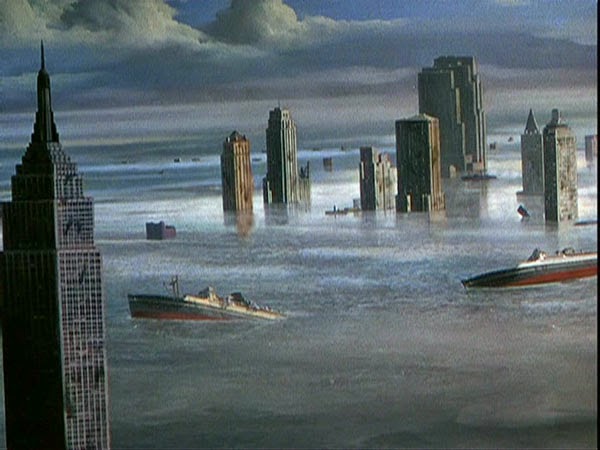
Water a way for New York to go...

Rudolph Maté's disaster film rattles along with a focus on his characters leading up to the end of the world rather than the Earth's destruction. Keating's Hendron is focused on carrying on human kind after Bellus hits Earth, and perfectly so. He is powerful, stern, and overwhelmingly caring at the same time. Next to Hoyt's angry Stanton, he seems like a saint, if not a little obsessive. He is the star of the film. Much like the rest of the film, the acting style from the other performers is a bit dated. Women lacking much personality, men arguing quickly and with little reasoning. Perhaps it is more a script based error, or the 89 minute runtime cutting out important character thought processes, but the film occasionally seems to jump wildly from one conclusion to another. However, there are some charming scenes with wonderful sections of dialogue, nearly all of them involving Keating's arguments with Stanton.

The new Thorpe Park ride is out of this world.

Whilst the film is dated, it never stops being enjoyable. There is a glorious feeling that comes from the merry optimism from a pre-moon landing America. Spaceships can be shot into space off of a roller coaster track and stars will not burn the atmosphere of Earth until very very close. As Bellus becomes close to Earth, the audience are treated to a montage of disasters (mostly pinched from other films) that show the oncoming end off the world and it is the only scene that really shows any destruction or effect of the star's passing, but it does it effectively. Waves ripping through a New York street, fires over an oil field, the normal. And in the closing stages of the film, a more powerful message becomes evident. The men who have not been selected for the flight riot and the question is raised: who decides who lives and dies? How would we, the audience, react? A minor moral underlying to an otherwise straight forward plot.


A nice, if not dated, view of the end of the world at nature's hand. Scientifically dreadful, but enjoyable none-the-less. The short runtime ensures it never drags, even if does sometime make large leaps forward.

Best Bit? The montage of the disasters followed by a the touching rescue of a boy stuck on a roof  in a flood (and the dishing out of supplies to survivors, though they won't survive for long, will they?)

Saturday, 1 March 2014

Evil Nuns

What happens when you put M and Alan Partridge on a journey into the past? Well who knows, but this is as close as we will get for now. This is Philomena.

Based on a true story of a disgraced politician, Martin Sixsmith (Steve Coogan) who, when he gets the sack, looks back at doing some journalism work. What he stumbles across is a human interests piece in the form of Philomena (Judie Dench), a little old Irish lady, who had her child taken from her by the nuns that were her guardians. The article becomes a thrilling thought to Martin. Evil nuns, a searching mother, a lost child, a tale spanning 50 years. It has everything needed for a successful story and so the pair set off, first to Ireland and then on to America to find the lost Anthony. But the tale is not simple, having to fight against dead ends and unhelpful sources, but can the two find what they are after - a reunion between mother and son?

'Bond, you look different'

What happens when you combine two of Britain's finest talents in a film together? Philomena, and it is splendid. Steve Coogan, who also wrote the film with Jeff Hope, does a wonderful job portraying Sixsmith as a cynical, world-weary fellow who just wants his story. Well, until half way into the film when we see his human side develop a little bit more. And Dame Judie Dench, the faultless Judie Dench (we will forget Chronicles of Riddick) as the delightful, yet somewhat grating, Philomena. But it is neither part is a solo act; this whole film is about the relationship of the two characters. Philomena, a simple woman with a lot of faith. Martin, a master with words that likes to investigated the complex. The two clash and collide but it makes for a seriously entertaining film. Laughs are often constructed by Sixsmith's annoyance of everything around him, tears are often wrenched by Philomena tugging on your heartstrings. It is a two person show, and by gosh, do they show. 

What a chairful couple.

A truly wonderful script by Coogan and Hope, brought to life masterfully by Stephen Frears. But it is the screenplay that stands out. As previously stated, this is a film about relationships, which are built on communication. From opening to close, there are lines that should be quoted again and again. Some notable moments are often about faith. The question of 'do you believe in God' gets thrown in there, to which Martin rambles for a while and finishes stating that there is no easy answer, then asks Philomena who gives a simple yes. And suddenly the characters are so clear in such a simple conversation, which is the mastery of writing for the screen. A brilliant achievement, and nominated around the board in recognition.  

Listed as a comedy, but still very much a tale told for the heart. It is exceedingly funny, but with enough sincerity that it never loses its power as a strong story.


Best Bit? The pair are in an airport discussing their books. Philomena begins to explain her book. I can guarantee that every audience goer will be able to identify with Martin's face as she goes on about horses. Realistic and hilarious. 

Friday, 28 February 2014

Old People

The road trip. Ram a load of young college kids into a VW van and you have a film. The destination does not matter. The sex and drinking do. Now what if you remove young college kids and replace them with old people. Keep the sex talk and the drinking. What do you get? This is Nebraska.

An ageing alcoholic by the name of Woody (Bruce Dern) gets a letter saying he has won $1million. Naturally, he wants to set straight out to claim his winnings so he begins to walk to Nebraska. From Montana. That's pretty far for a 77 year old. His sons David (Will Forte) and Ross (Bob Odenkirk), and his wife Kate (June Squibb) try to convince him that is all a scam, but Woody is stubborn and eventually David agrees to take him. After hitting some troubles on route, they stay with some family in Hawthorne, Nebraska where Woody grew up, and Woody begins to explore his old town. When he reveals that he has won some money, he becomes a local celebrity and everyone wants to be his friend, or get some money out of him. Cue a lot of bar scenes and a lot of swearing from an old lady, this is the road trip of the future featuring heroes from the past.

'Murica
Bruce Dern, at 77 years of age, is getting the leading man acclaim that he well and truly deserves. Woody is an incredibly realised performance who is entirely loveable and at the same time it is impossible to not fully identify with Forte's David and his annoyance at his father. Speaking of Forte, a man known for his comedy work, puts in a fantastic turn here. Further proof that comedy actors should not be limited as such. Whilst the film is absolutely hilarious, it is the reality of the relationship primarily between David and Woody that makes the film so honestly touching. There is a true sense of family between all the leads and a clear, real love for Woody from Squibb's Kate. At first she comes across as a cynical, grumpy old lady, but as the narrative progresses, we see what she has to deal with on a daily basis with Woody and suddenly you realise how much she truly loves him. It is the most honest representation of ageing love since Amour. 

She's just a little old lady... oh.
With an absolutely exceptional script by Bob Nelson, Nebraska rattles along in black and white doing something extremely risky in mainstream cinema. It shows people as they are. It does not cast these gloriously attractive actors to play us normal people. And by shooting the film in black and white, an overwhelming sense of melancholy settles over the film, despite it being so funny. Alexander Payne's direction has a clear sense of purpose, filling the film with long shots of a colourless Nebraska farmland with small silhouettes of his characters looking out over the land. Time is precious, detail is important, but most of all, keeping good relationships will get you far in this world.

A truly spectacular achievement in cinema. Absolutely beautiful to watch and gloriously meaningful. Plus, ridiculously funny and also extremely touching. Payne's newest masterpiece has it all and it is one you could watch again and again.


Best Bit? Perhaps it fits quite well with the dampened happiness of the film but the family take a trip to the cemetery to see where Woody's family are buried. Kate, who clearly did not get on with them all too well, discusses each grave in turn that would have the deceased rolling under her feet. 

Everyone Has AIDS

This awards season has brought a lot of intimate, personal stories, and many of them from history. Today we dive back only a few decades to a story that speaks of something extremely important. But how well does it do it? This is Dallas Buyers Club.

Ron (Matthew McConaughey) is just your average rodeo bull riding electrician. The kind of guy that hires hookers to bang him behind the gates of the bull ring after he has done his dealings as a bookie, but before he goes to drink and snort cocaine with his friends. The normal. One day, however, that all changes when he is diagnosed as HIV positive - the disease of 'faggots' - saying he only has thirty days to live, and so naturally his homophobic friends abandon him. The doctors cannot give him AZT, the medicine he really wants as it is only in the trial stages, so he finds a way around the system after meeting a Mexican doctor, Dr. Vass (Griffin Dunne). Teaming up with transsexual Rayon (Jared Leto), Ron begins to smuggle in drugs to help himself, but eventually realises he is not the only one who needs help. He sets up a system for other AIDS suffers, despite arguments from Dr. Sevard (David O'Hare) and Dr. Eve Saks (Jennifer Garner), and calls it the Dallas Buyers Club.

The title 'Hugs and Drugs' did not test well with audiences.

McConaughey, an actor whose name, when attached to a movie, meant you should probably avoid whatever the project was. Here he is now with an Academy Award nomination. (He's also in the nominated The Wolf of Wall Street.) Why? Because he is fantastic. As Ron, McConaughey shows that there is a lot of power in his performance. Unlike some recent performances that leave subtlety in the past and prefer the explicit, McConaughey understands Ron and all he is feeling, from the desperation for suitable medicine, to the need to help others, to the fear of death, McConaughey gets it right. But the real stand out is Leto. As transsexual Rayon, Leto is completely unrecognisable. He is completely absorbed in his role and sucks the audience in too. A loving, and loveable character, with the social skills that Ron fails to possess in the gay community, Leto's Reyon is easily one of the finest performances of the year. He is very similar to the famous Angel, from the musical Rent. The two leads hold the film, their supporting cast to little to add much. Fortunately, the pair at the front need little help.

That security man is missing the point.

A cleverly constructed tale of the good and bad sides of humanity. The darkness that is how much can be achieved when desperation is the driving force, but also the hope that comes with that. One man finds a solution for his problem and unlike the money-centric companies that control the medicine, he tries to make a difference. With some of the best editing of the year, the film never feels like the two hour runtime that it is and along with such an engaging script and fantastic direction from Jean-Marc Vallée, Dallas Buyers Club is an important story of struggling with the American healthcare system. It is, as some other critics have stated, possibly being told too late to pack the punch it could have 20 years ago, but it is still an inspirational tale. 

A story that has a lot of everything. Some happy bits, some sad bits, some bits that will make you angry. It is a tale that shows the dangers of greed and hate and the benefits of caring for others. 


Best Bit? Ron dons a priest outfit as he smuggles drugs across the border from Mexico to the USA. He's stopped. Perhaps it is our sympathetic relationship with Ron, but c'mon. Who stops a priest?

(Note: I've seen claims that the only reason McConaughey is getting attention is because he lost a lot of weight. I've not spoken about his weight loss because, whilst it advances his character, he is truly talented too.)


Wednesday, 26 February 2014

Siri

Sci-fi. Aliens, robots, space. All that cool stuff, right? Well what about love in a not too distance future? Companies that write love letters? Cyber sex? This is Her.

In the not-too-distant future, there is Theodore (Joaquin Phoenix) , a lonely love letter writer, avoiding signing his divorce papers. He goes home at night, plays video games, and has, very strange, phone sex. His friend Amy (Amy Adams) tries to get him out, to set him up with her friends, and force him out of his slump. But nothing works until Theodore installs a new operating system on his computer, an artificial intelligence that adapts and evolves as it learns. The OS calls herself Samantha (voiced by Scarlett Johansson) and she form a bond with Theodore. Together they organise his life, write his letters, and begin to date. Weird right? Can it work out or will it crash and burn?

'I love Lamp'

Much in the same way Moon was a one man show, Her is held entirely by Phoenix.While Johansson's voice work is delightful, with her soft and subtle tones, picking up on every minor nuance of emotion, it is Phoenix who makes the film special. There is a real loneliness in his performance, the sense of true sadness until Samantha comes into his life. But the change from sadness to happiness is not a quick one. Covering a whole spectrum from cynicism to joy to carelessness, Theodore is undoubtedly a fully developed character from start to finish. Adams' Amy is her best role of the past year (yes, better than American Hustle) as she accompanies Theodore on his journey into love and develops something similar with her own Operating System. She plays an important role in the development of Samantha and Theodore's relationship, be it encouraging it, or being questioned by Samantha.

Secretly, who hasn't wanted to tuck their partner in their pocket?

There is something wonderfully unique and - possibly brutally - truthful about Her. In the world we live in today, technology is being programmed to be almost human. Of course, it is not the first time that artificial intelligence, and relationships with technology, have been the focus of the big screen, but it is the first time it has seemed so believable. Spike Jonze has created something that, with the invention of things like Siri, has a high possibility of happening. However, whilst the first two thirds of Her are something highly unique, the final chapter seems a bit too familiar. The focus in the final third, it has been speculated, should be heavily on Theodore's ending in the tale, which it looks like Jonze intended, but something is missing; something new to finish off the well known story that Her becomes towards the end.

All in all, a romantic sci-fi with hints of drama and comedy, on paper, sounds like the strangest thing to happen to cinema in a long while. And it is, in some respects, but it says something powerful about mankind's dependency on technology, and that message should be listened to.


Best Bit? As we see the bond between Samantha and Theodore develop they play a game where he closes his eyes and she gives him instructions. His childlike happiness is so contagious that you will not be able to stop yourself smiling along.